Animal adaptation practice
Camouflage Word Search Printable
Camouflage can make an organism harder to notice in its surroundings. Children can use this printable to practice relevant vocabulary, then look closely at how colors, patterns, shadows, and textures affect what they see.
Start with the printable
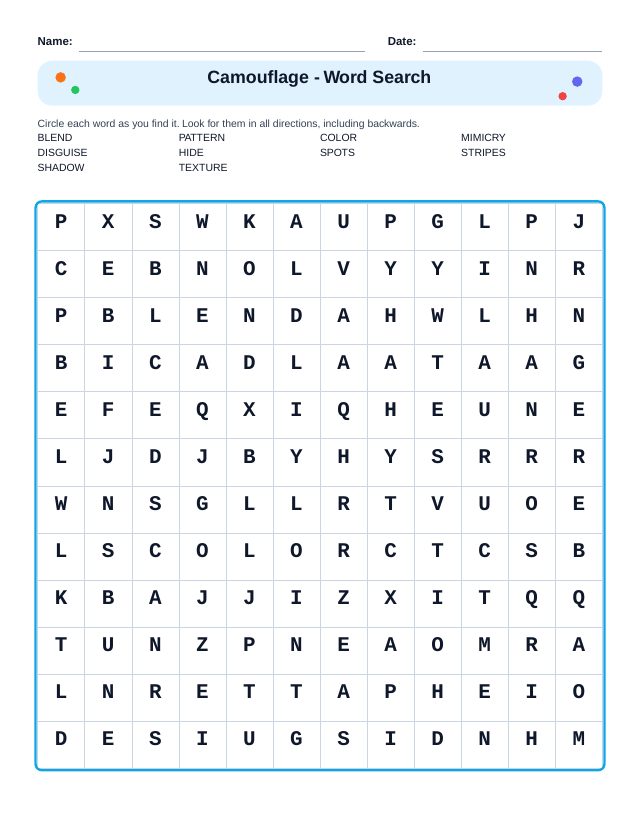
Use the words before and after the puzzle
Before solving, ask your child to circle unfamiliar words in the list. Afterward, choose three words to explain, draw, or use in a science sentence. Open the printable PDF below when you are ready.
What children can practice
- Recognize features that can make an organism less noticeable.
- Connect an animal’s appearance with a particular environment.
- Use observations as evidence when explaining an adaptation.
For parents and homeschool
Design a hidden paper creature
Choose a patterned surface at home and give your child a small piece of paper and coloring tools.
- Step 1
Study the surface’s colors, shapes, light areas, and shadows.
- Step 2
Draw a tiny creature whose body pattern fits that background.
- Step 3
Place it on the surface and explain which design choices make it easier or harder to spot.
Also useful for teachers
A quick classroom adaptation
Pair the printable with habitat photographs. Students can select one habitat, design an adapted animal, and support each color, pattern, or texture choice with evidence from the image.
Questions to talk about
- Would the same camouflage work in every habitat?
- How can shadows change what is easy to see?
- How might camouflage help both predators and prey?