Animal Classification Word Search
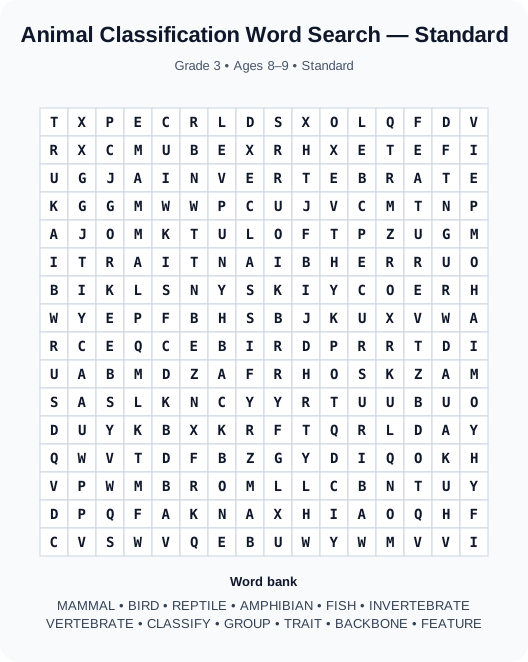
- Free
- No account
- Answer key
- Standard
- About 18 min
- 12 words
One printable file with the activity first and the answer key after it.
Download a free Grade 3 animal classification word search PDF with an answer key, group definitions, a sorting activity, and an exit ticket.
For parents and caregivers
What your child will practice
- Classify familiar animals using observable traits such as backbones, coverings, and breathing structures.
- Explain that classification groups organisms by shared features while allowing variation within a group.
How to use this puzzle at home
- Preview the five vertebrate groups and compare two familiar animals before starting.
- Complete the word search and check each classification term with the answer key.
- Sort animal pictures or names by shared traits and explain one decision aloud.
What you need
- Printed worksheet or PDF viewer
- Pencil or highlighter
- Optional animal photographs or sorting cards
Word List
- MAMMAL
- BIRD
- REPTILE
- AMPHIBIAN
- FISH
- INVERTEBRATE
- VERTEBRATE
- CLASSIFY
- GROUP
- TRAIT
- BACKBONE
- FEATURE
Printable Puzzle
Open Puzzle PDFOpen Answer KeyDownload Worksheet + Answer Key
Vocabulary guide
Use these short definitions before or after the word search. Ask your child to explain a few in their own words.
- Mammal
- A vertebrate animal with hair or fur whose young drink milk produced by the mother.
- Bird
- A vertebrate animal with feathers, a beak, and eggs with shells.
- Reptile
- A vertebrate animal with dry scales that usually lays leathery-shelled eggs.
- Amphibian
- A vertebrate animal that usually begins life in water and changes form as it grows.
- Fish
- An aquatic vertebrate that usually breathes through gills and has fins.
- Invertebrate
- An animal that does not have a backbone or spinal column.
- Vertebrate
- An animal with a backbone or spinal column inside its body.
- Classify
- To arrange organisms or objects into groups using shared characteristics.
- Group
- A set of organisms or objects placed together because they share selected features.
- Trait
- An observable characteristic of an organism, such as feathers, scales, or number of legs.
- Backbone
- The connected bones forming the spinal column of a vertebrate animal.
- Feature
- A noticeable structure, behavior, or other characteristic used for comparison.
Talk about the science
- Which traits are most useful when deciding whether an animal is a bird or mammal?
- Why is a whale classified as a mammal instead of a fish?
- Can two animals in the same group look very different? Give an example.
Quick check
Measurable exit ticket
Exit ticket: classify three animals, identify whether each is a vertebrate or invertebrate, and cite one observable feature supporting every classification. Include one comparison between two groups.
Try one more thing
Extension activity
Choose six animals and create a branching classification key using visible traits. Ask someone else to follow the key, note where it works or causes confusion, and revise one question to make the groups clearer.
Teacher and tutor note
Classroom adaptation
Pairs receive unfamiliar animal cards and a trait chart. After completing the puzzle, they classify each animal, record the evidence used, and identify one case where more information would be needed before deciding.
Differentiation and accommodations
Extra support
Provide a picture key showing feathers, fur, scales, fins, gills, and backbones before the learner sorts animals.
More challenge
Ask the learner to construct a two-step classification key for a small set of animals and test it with a partner.
Access options
- Allow pointing, matching, or oral classification instead of extended writing.
- Offer enlarged animal photographs and a larger puzzle grid.
- Preteach one representative animal for each major group.
Accessibility
The complete word bank, definitions, and directions are selectable HTML and support browser zoom and keyboard navigation. The PDF and optional image cards rely on visual information, so provide detailed descriptions, tactile models, or oral sorting choices when needed.
Keep learning
Same Grade
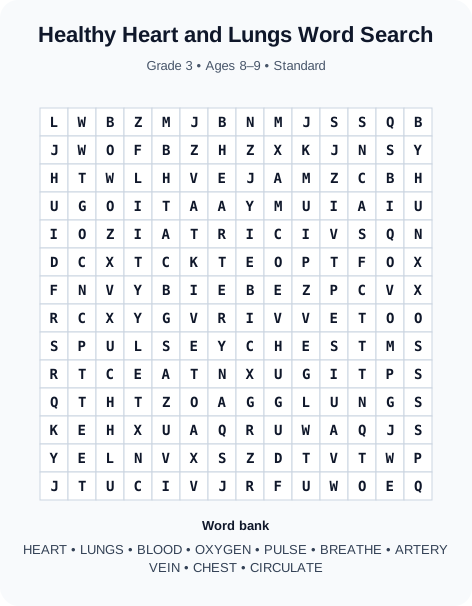
Healthy Heart and Lungs Word Search
Keep learning at Grade 3
Ready for another puzzle?
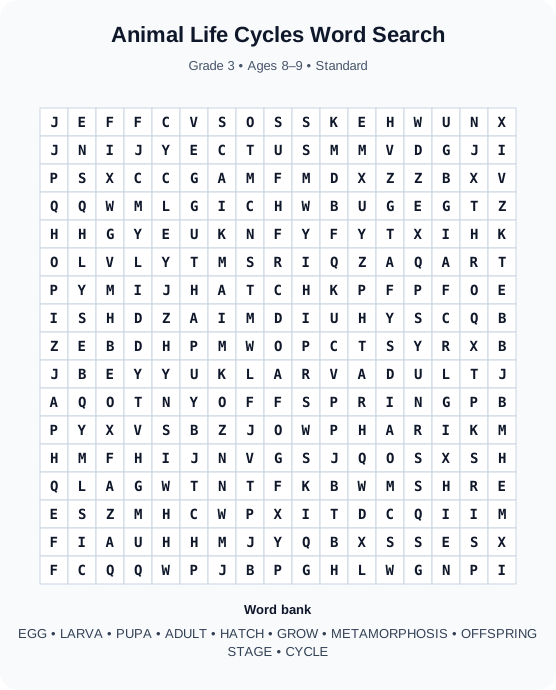
Animal Life Cycles Word Search
Continue with a different science topic at a familiar level.
Continue learning