Busy Bees and Pollinators Word Search
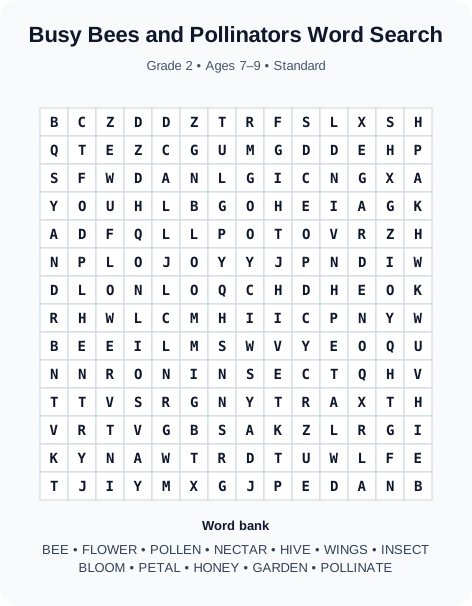
- Free
- No account
- Answer key
- Standard
- About 15 min
- 12 words
A printable pollinator word search with an answer key, simple definitions, and ideas for learning and vocabulary practice at home or in class.
For parents and caregivers
What your child will practice
- Recognize vocabulary connected to bees, flowers, and pollination.
- Explain that pollinators move pollen between flowers.
- Use science vocabulary in a spoken or written observation.
How to use this puzzle at home
- Read the word bank together and ask your child which words are familiar.
- Let your child find and circle the words independently, offering a hint only when needed.
- Use the definitions and discussion questions after the puzzle to connect the words to real plants and insects.
Word List
- BEE
- FLOWER
- POLLEN
- NECTAR
- HIVE
- WINGS
- INSECT
- BLOOM
- PETAL
- HONEY
- GARDEN
- POLLINATE
Printable Puzzle
Vocabulary guide
Use these short definitions before or after the word search. Ask your child to explain a few in their own words.
- Bee
- An insect that visits flowers and can carry pollen.
- Flower
- The part of many plants that makes seeds.
- Pollen
- Tiny grains made by flowers that help plants make seeds.
- Nectar
- A sweet liquid inside flowers that attracts pollinators.
- Hive
- A home where a colony of honeybees lives.
- Wings
- Body parts that help bees and other insects fly.
- Insect
- An animal with six legs and three main body parts.
- Bloom
- A flower, or the act of a flower opening.
- Petal
- A colorful flower part that can attract pollinators.
- Honey
- Sweet food that honeybees make from nectar.
- Garden
- A place where people grow flowers, vegetables, or other plants.
- Pollinate
- To move pollen so a plant can make seeds.
Talk about the science
- Why do you think flowers make nectar?
- How can a bee help a plant while collecting food?
- What could people plant to help pollinators in their neighborhood?
Try one more thing
Extension activity
Pollinator watch: observe one flowering plant for five quiet minutes. Tally every insect visitor, sketch one visitor, and describe which flower part it touched. Observe from a safe distance and do not touch insects.
Teacher and tutor note
Classroom adaptation
Use the puzzle individually as a vocabulary warm-up, in pairs at a science center, or with a small group before observing flowers outdoors. Early finishers can label a bee-and-flower diagram with words from the page.
Keep learning
Same Grade
Seed to Plant Life Cycle Word Search
Related Topic
Plant Parts in the Garden Word Search
Keep learning at Grade 2
Ready for another puzzle?
Earth Changes: Wind and Water Word Search
Continue with a different science topic at a familiar level.
Continue learning