Four Seasons and Weather Word Search
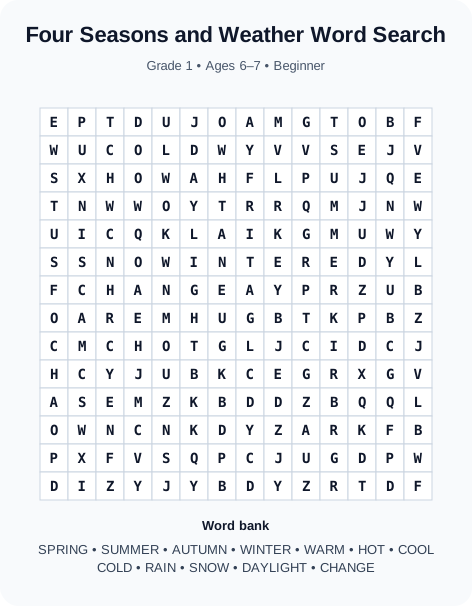
- Free
- No account
- Answer key
- Beginner
- About 14 min
- 12 words
Compare spring, summer, autumn, and winter weather with a family-friendly puzzle and printable answer key for home or class.
For parents and caregivers
What your child will practice
- Name spring, summer, autumn, and winter as the four seasons in a yearly cycle.
- Use weather and daylight words to compare seasonal patterns without treating them as universal.
How to use this puzzle at home
- Name the four seasons together and discuss which weather patterns your family notices locally.
- Have your child complete the puzzle, then compare all circled words with the answer key.
- Choose two seasons and make a spoken comparison using at least four vocabulary words.
Word List
- SPRING
- SUMMER
- AUTUMN
- WINTER
- WARM
- HOT
- COOL
- COLD
- RAIN
- SNOW
- DAYLIGHT
- CHANGE
Printable Puzzle
Vocabulary guide
Use these short definitions before or after the word search. Ask your child to explain a few in their own words.
- Spring
- A season when many places become warmer and new plants grow.
- Summer
- A season that often has warmer weather and longer daylight.
- Autumn
- A season when many places cool and some tree leaves change.
- Winter
- A season that often has colder weather and shorter daylight.
- Warm
- Having a comfortably higher temperature but not feeling very hot.
- Hot
- Having a high temperature compared with nearby conditions.
- Cool
- Having a somewhat lower temperature without being extremely cold.
- Cold
- Having a low temperature compared with nearby conditions.
- Rain
- Liquid water drops that fall from clouds to the ground.
- Snow
- Frozen ice crystals that can fall from clouds in cold air.
- Daylight
- Natural light present between sunrise and sunset.
- Change
- To become different from how something was before.
Talk about the science
- Which seasonal changes can you observe where you live?
- How can daylight and temperature change from one season to another?
- Why might winter look different in two parts of the world?
Try one more thing
Extension activity
Keep a seven-day weather-and-daylight journal. Draw the sky, record whether the air feels hot, warm, cool, or cold, and identify one pattern at the end of the week.
Teacher and tutor note
Classroom adaptation
Create four labeled season corners. After solving, students place weather-word cards where they commonly fit, then discuss why local climates may make more than one placement reasonable.
Keep learning
Same Grade
Plant Parts in the Garden Word Search
Related Topic
Weather Watchers Word Search
Keep learning at Grade 1
Ready for another puzzle?
Healthy Daily Habits Word Search
Continue with a different science topic at a familiar level.
Continue learning