Gravity and Earth's Pull Word Search
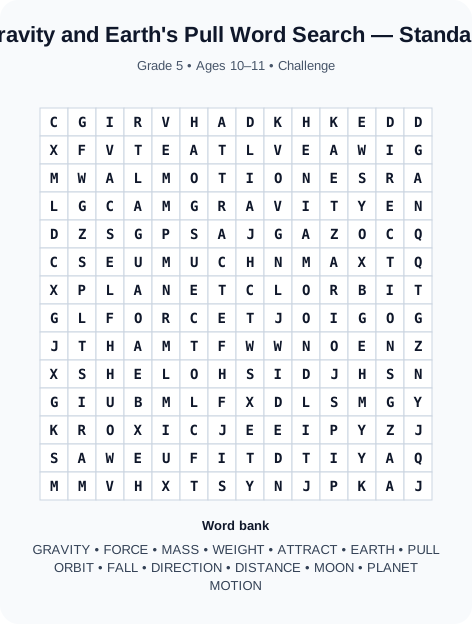
- Free
- No account
- Answer key
- Challenge
- About 22 min
- 14 words
One printable file with the activity first and the answer key after it.
Download a free Grade 5 gravity word search PDF with an answer key, accurate definitions, force diagrams, and a simple evidence-based activity.
For parents and caregivers
What your child will practice
- Explain gravity as an attractive force exerted by Earth on objects near its surface.
- Distinguish mass from weight and use arrows to represent the direction of gravitational force.
How to use this puzzle at home
- Preview mass, weight, gravity, and orbit and discuss how the terms differ.
- Complete the word search and use the answer key to verify each term.
- Draw force arrows for three safe objects resting on or falling toward Earth and compare their direction.
What you need
- Printed worksheet or PDF viewer
- Pencil and ruler
- Optional object-and-force diagram cards
Word List
- GRAVITY
- FORCE
- MASS
- WEIGHT
- ATTRACT
- EARTH
- PULL
- ORBIT
- FALL
- DIRECTION
- DISTANCE
- MOON
- PLANET
- MOTION
Printable Puzzle
Open Puzzle PDFOpen Answer KeyDownload Worksheet + Answer Key
Vocabulary guide
Use these short definitions before or after the word search. Ask your child to explain a few in their own words.
- Gravity
- An attractive force between objects that have mass.
- Force
- A push or pull that can affect an object's motion.
- Mass
- A measure of the amount of matter in an object.
- Weight
- The force of gravity acting on an object, which can change with location.
- Attract
- To pull one object toward another object.
- Earth
- The planet whose gravity pulls nearby objects toward its center.
- Pull
- A force directed toward an object, location, or center.
- Orbit
- The curved path of one object around another because of motion and gravity.
- Fall
- To accelerate toward Earth or another body because of gravity.
- Direction
- The course along which a force acts or an object moves.
- Distance
- The amount of space between two objects or positions.
- Moon
- Earth's natural satellite, held in orbit partly by gravitational attraction.
- Planet
- A large nearly round body that travels in an orbit around a star.
- Motion
- A change in an object's position over time relative to a reference point.
Talk about the science
- How are mass and weight different?
- Why does gravity pull objects in different places toward Earth's center?
- How can the Moon keep moving without flying straight away from Earth?
Quick check
Measurable exit ticket
Exit ticket: define mass and weight in different words, draw a gravitational-force arrow on an object near Earth, and explain why the arrow points toward Earth's center.
Try one more thing
Extension activity
Create a four-panel gravity model showing an object resting on Earth, falling, located on the Moon, and orbiting Earth. Add force arrows and a short explanation of how mass, weight, motion, and distance apply in each panel.
Teacher and tutor note
Classroom adaptation
After the puzzle, pairs analyze diagrams of objects near Earth and the Moon. They add gravitational-force arrows, distinguish mass from weight, and critique one common claim such as heavier objects always fall faster because gravity ignores air resistance.
Differentiation and accommodations
Extra support
Use a globe or circle diagram and let the learner place arrows pointing toward the center from several locations.
More challenge
Ask the learner to explain how gravity and forward motion work together to keep the Moon in orbit without requiring advanced calculations.
Access options
- Provide tactile or raised-line arrows and a large Earth diagram.
- Accept an oral explanation or speech-to-text response.
- Use prerecorded demonstrations instead of dropping objects when sound or motion is distracting.
Accessibility
The page includes selectable HTML definitions and instructions with keyboard navigation and zoom. Force diagrams and the puzzle grid are visual, so provide raised-line arrows, tactile models, detailed descriptions, or verbal response options when appropriate.
Keep learning
Keep learning at Grade 5
Ready for another puzzle?
Matter, Mixtures, and Changes Word Search
Continue with a different science topic at a familiar level.
Continue learning