Light and Shadows Word Search
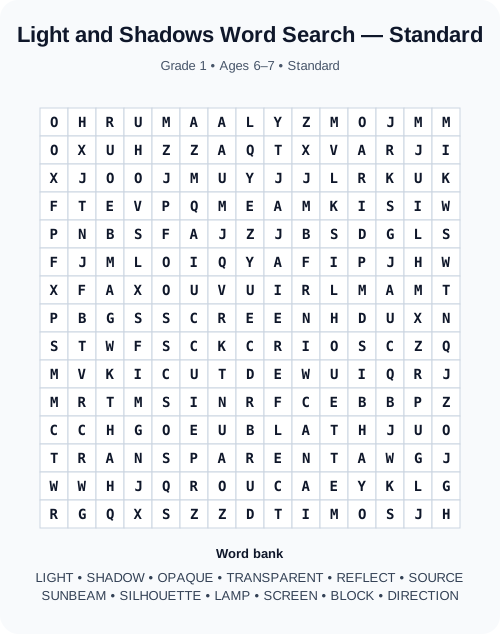
- Free
- No account
- Answer key
- Standard
- About 16 min
- 12 words
One printable file with the activity first and the answer key after it.
Choose the right level
Easy, Standard, or Challenge
Easy
8 words · About 10 min
Standard
12 words · About 16 min
Challenge
18 words · About 24 min
Download a free Grade 1 light and shadows word search PDF with three difficulty levels, an answer key, definitions, and a flashlight activity.
For parents and caregivers
What your child will practice
- Explain that light travels from a source and a shadow forms when an object blocks the light.
- Compare how clear, translucent, and opaque materials affect transmitted light.
How to use this puzzle at home
- Preview the word bank and identify safe light sources such as the Sun, a lamp, or a flashlight.
- Complete the chosen puzzle level and use its answer key to check every term.
- With adult supervision, shine a flashlight at an object and move the object nearer to and farther from a wall.
What you need
- Printed worksheet or PDF viewer
- Pencil or highlighter
- Optional flashlight, safe objects, and blank wall
Word List
- LIGHT
- SHADOW
- OPAQUE
- TRANSPARENT
- REFLECT
- SOURCE
- SUNBEAM
- SILHOUETTE
- LAMP
- SCREEN
- BLOCK
- DIRECTION
Printable Puzzle
Open Puzzle PDFOpen Answer KeyDownload Worksheet + Answer Key
Vocabulary guide
Use these short definitions before or after the word search. Ask your child to explain a few in their own words.
- Light
- Energy that travels from a source and makes objects visible to our eyes.
- Shadow
- A darker area formed when an object blocks light from reaching a surface.
- Opaque
- Describes a material that blocks nearly all visible light.
- Transparent
- Describes a material that lets most visible light pass through clearly.
- Reflect
- To bounce light away from a surface instead of letting it pass through.
- Source
- An object or place from which light is produced or begins to travel.
- Sunbeam
- A visible beam or stream of light coming from the Sun.
- Silhouette
- A dark outline seen when an object is between a viewer and a bright background.
- Lamp
- A human-made light source that changes electrical energy into light.
- Screen
- A surface on which light and shadows can be observed.
- Block
- To stop light from continuing along part of its path.
- Direction
- The path or course along which light travels from its source.
- Translucent
- Describes a material that lets some light through but scatters it.
- Beam
- A narrow path or stream of light traveling in one general direction.
- Bright
- Giving off or reflecting a large amount of visible light.
- Dim
- Giving off or reflecting only a small amount of visible light.
- Distance
- The amount of space between the light source, object, and screen.
- Angle
- The amount of turn between two directions or lines.
Talk about the science
- What must be present for a shadow to form?
- Why does clear plastic affect light differently from cardboard?
- How does moving an object change the shadow you observe?
Quick check
Measurable exit ticket
Exit ticket: draw a light source, an object, a screen, and the resulting shadow. Add arrows for light direction and write one sentence explaining why the shadow forms.
Try one more thing
Extension activity
Create three shadow outlines by changing the position of one safe object relative to a flashlight and wall. Label the source, object, and shadow in each drawing, then describe one pattern you notice.
Teacher and tutor note
Classroom adaptation
Set up stations with a flashlight, screen, and safe transparent, translucent, and opaque materials. After the puzzle, groups predict and record how each material changes the light or shadow, then share one evidence-based comparison.
Differentiation and accommodations
Extra support
Use the Easy grid, preview each object with a picture, and trace the light path with a finger before searching.
More challenge
Use the Challenge grid and explain how distance and angle can change a shadow's size, position, or shape.
Access options
- Offer high-contrast materials and a larger printed grid.
- Allow oral predictions and observations instead of written sentences.
- Avoid flashing lights and provide a static diagram for learners with light sensitivity.
Accessibility
All vocabulary, definitions, and directions appear as selectable HTML and can be enlarged with browser zoom. The PDFs are visual and untagged, and the optional flashlight investigation should be replaced with a static high-contrast diagram for learners sensitive to light.
Keep learning
Same Grade
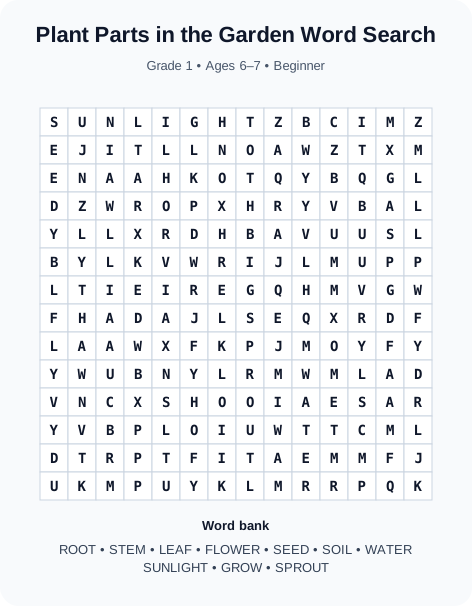
Plant Parts in the Garden Word Search
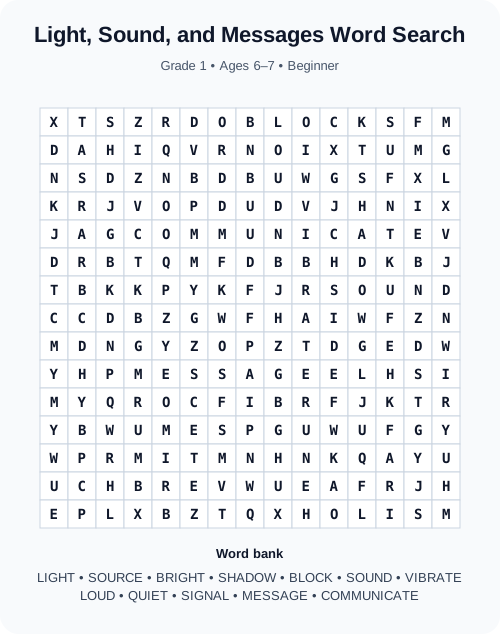
Keep learning at Grade 1
Ready for another puzzle?
Light, Sound, and Messages Word Search
Continue with a different science topic at a familiar level.
Continue learning