Living and Nonliving Things Word Search
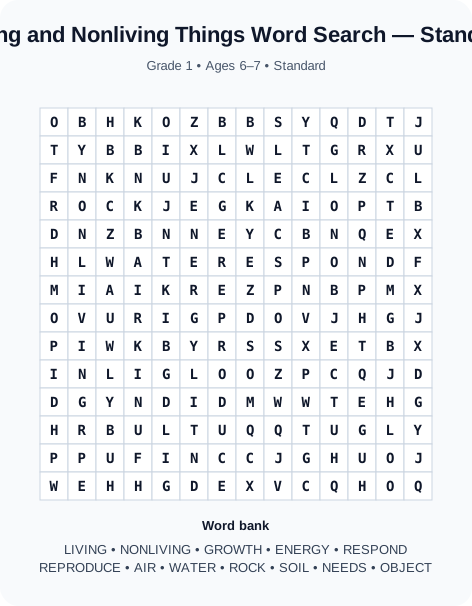
- Free
- No account
- Answer key
- Standard
- About 16 min
- 12 words
One printable file with the activity first and the answer key after it.
Choose the right level
Easy, Standard, or Challenge
Easy
8 words · About 10 min
Standard
12 words · About 16 min
Challenge
18 words · About 24 min
Download a free Grade 1 living and nonliving things word search PDF with three levels, an answer key, definitions, and a sorting activity.
For parents and caregivers
What your child will practice
- Identify common characteristics that living things share, including growth and basic needs.
- Use observable evidence to sort familiar examples as living or nonliving.
How to use this puzzle at home
- Preview the word bank and ask your child to name one living and one nonliving example nearby.
- Choose the difficulty level, complete the word search, and check the grid with the matching answer key.
- Sort six household or outdoor examples and ask for one observable reason behind each choice.
What you need
- Printed worksheet or PDF viewer
- Pencil or highlighter
- Optional household objects or picture cards
Word List
- LIVING
- NONLIVING
- GROWTH
- ENERGY
- RESPOND
- REPRODUCE
- AIR
- WATER
- ROCK
- SOIL
- NEEDS
- OBJECT
Printable Puzzle
Open Puzzle PDFOpen Answer KeyDownload Worksheet + Answer Key
Vocabulary guide
Use these short definitions before or after the word search. Ask your child to explain a few in their own words.
- Living
- Describes an organism that uses energy, grows, responds, and carries out life processes.
- Nonliving
- Describes something that does not carry out life processes on its own.
- Growth
- A change in size or development that occurs as a living thing matures.
- Energy
- What living things need to grow, move, repair themselves, and stay alive.
- Respond
- To react to a change such as light, sound, temperature, or touch.
- Reproduce
- To make new living things of the same general kind.
- Air
- The mixture of gases around Earth that living things use in different ways.
- Water
- A substance needed by every known living thing to carry out life processes.
- Rock
- A naturally occurring nonliving material made from one or more minerals.
- Soil
- A mixture of mineral pieces, air, water, and once-living material where many plants grow.
- Needs
- Things an organism must obtain from its surroundings in order to live.
- Object
- A particular thing that can be observed and described by its properties.
- Organism
- An individual living thing, such as one plant, animal, fungus, or bacterium.
- Food
- Material that provides nutrients and energy to an animal or other organism.
- Habitat
- The place where an organism lives and finds what it needs.
- Plant
- A living thing that usually makes sugars using light, water, and carbon dioxide.
- Animal
- A living thing that gets energy by eating plants, animals, or other organisms.
- Cell
- The smallest structural unit that makes up every living organism.
Talk about the science
- Why is a plant living even though it does not walk from place to place?
- Can something be nonliving now but come from a living thing? Give an example.
- What evidence would help you decide whether an unfamiliar object is living?
Quick check
Measurable exit ticket
Exit ticket: classify one plant, one animal, and two nonliving objects. For each answer, give one relevant observation about growth, needs, response, reproduction, or the absence of life processes.
Try one more thing
Extension activity
Make a two-column observation chart for ten things found at home or outdoors. Classify each as living or nonliving, record one piece of evidence, and circle any example that was once part of a living thing.
Teacher and tutor note
Classroom adaptation
After the puzzle, partners sort picture cards into living, once-living, and never-living groups. They choose two cards and defend each placement with an observable characteristic rather than relying only on movement.
Differentiation and accommodations
Extra support
Begin with the Easy version and let the learner handle or view familiar objects while discussing each word.
More challenge
Use the Challenge version, then compare a dormant seed, a fallen leaf, and a toy robot using evidence.
Access options
- Read definitions aloud and allow pointing, sorting, or oral responses.
- Print at a larger scale or use browser zoom for a larger grid and word bank.
- Provide two labeled sorting mats to reduce writing demands.
Accessibility
The page repeats all words, definitions, and instructions as selectable HTML and supports keyboard navigation and browser zoom. The visual puzzle PDFs are not tagged for screen readers, so offer the HTML guide, a reader, or a hands-on sorting option when needed.
Keep learning
Same Grade
Plant Parts in the Garden Word Search
Keep learning at Grade 1
Ready for another puzzle?
Plant and Animal Structures Word Search
Continue with a different science topic at a familiar level.
Continue learning