Magnets and Magnetic Forces Word Search
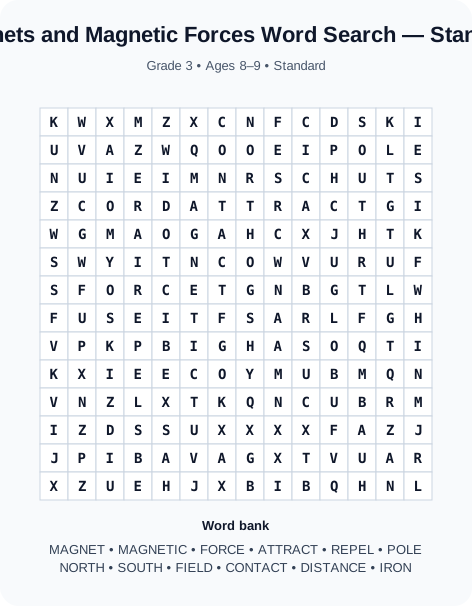
- Free
- No account
- Answer key
- Standard
- About 18 min
- 12 words
One printable file with the activity first and the answer key after it.
Download a free Grade 3 magnets and magnetic forces word search PDF with an answer key, definitions, predictions, and a simple investigation.
For parents and caregivers
What your child will practice
- Describe magnetic attraction and repulsion as forces that can act without direct contact.
- Use observations to predict how magnetic poles and selected materials will interact.
How to use this puzzle at home
- Preview the terms and make predictions about several safe household materials before testing anything.
- Complete the word search and confirm the vocabulary with the answer key.
- With adult supervision, test a magnet near approved objects and record whether each object is attracted.
What you need
- Printed worksheet or PDF viewer
- Pencil or highlighter
- Optional magnets and teacher-approved test objects
Word List
- MAGNET
- MAGNETIC
- FORCE
- ATTRACT
- REPEL
- POLE
- NORTH
- SOUTH
- FIELD
- CONTACT
- DISTANCE
- IRON
Printable Puzzle
Open Puzzle PDFOpen Answer KeyDownload Worksheet + Answer Key
Vocabulary guide
Use these short definitions before or after the word search. Ask your child to explain a few in their own words.
- Magnet
- An object that produces a magnetic field and can attract certain materials.
- Magnetic
- Describes a material, object, or force affected by a magnetic field.
- Force
- A push or pull that can change an object's motion or shape.
- Attract
- To pull objects or opposite magnetic poles toward each other.
- Repel
- To push objects or like magnetic poles away from each other.
- Pole
- One of the two regions of a magnet where its magnetic effects are strongest.
- North
- The label given to one end or pole of a magnet.
- South
- The label given to the magnetic pole opposite the north pole.
- Field
- The region around a magnet where magnetic forces can act.
- Contact
- Direct touching between two objects or surfaces.
- Distance
- The amount of space between two objects or positions.
- Iron
- A metal that is strongly attracted to many common magnets.
Talk about the science
- How can a magnet move an object without touching it?
- What happens when like poles and opposite poles face each other?
- Why are some metal objects attracted to a magnet while others are not?
Quick check
Measurable exit ticket
Exit ticket: draw two magnet interactions, one showing attraction and one showing repulsion. Label the poles, use arrows for force direction, and explain how the interaction can occur without contact.
Try one more thing
Extension activity
Design a fair test for how distance affects magnetic attraction. Choose one object, keep the magnet and setup consistent, measure several starting distances, and make a claim supported by the recorded results.
Teacher and tutor note
Classroom adaptation
After the puzzle, teams test a labeled set of safe materials and record predictions and outcomes. They then investigate pole interactions and write one claim supported by observations about attraction, repulsion, or distance.
Differentiation and accommodations
Extra support
Use arrows and color-coded pole labels while the learner predicts pull together or push apart before using formal terms.
More challenge
Ask the learner to investigate how increasing distance changes a magnet's observable effect and design a fair comparison.
Access options
- Provide large magnets or handled magnetic tools when fine-motor access is limited.
- Accept oral predictions and conclusions or provide a scribe.
- Use a demonstration video or diagram if magnets could interfere with a medical or assistive device.
Accessibility
The page provides all text in selectable HTML with keyboard navigation and browser zoom. The optional investigation requires caution around magnetic medical or assistive devices; use a narrated demonstration or tactile arrows instead when direct magnet use is unsuitable.
Keep learning
Same Grade
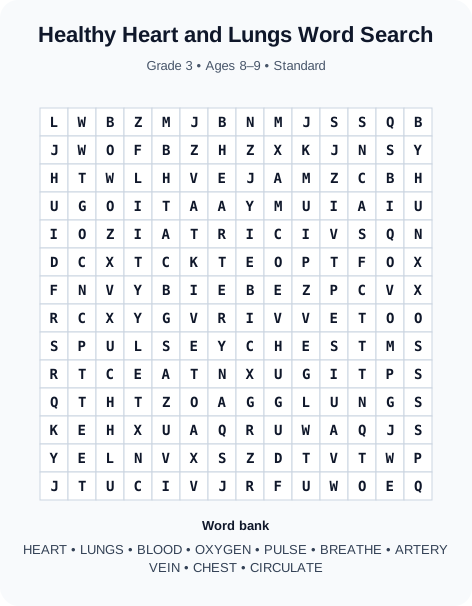
Healthy Heart and Lungs Word Search
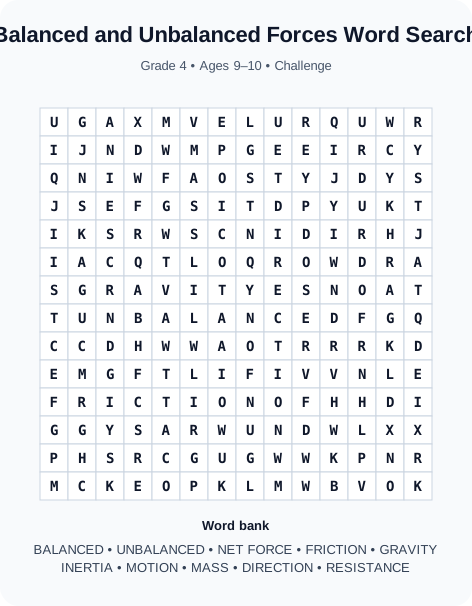
Continue with force and motion
Ready for another puzzle?
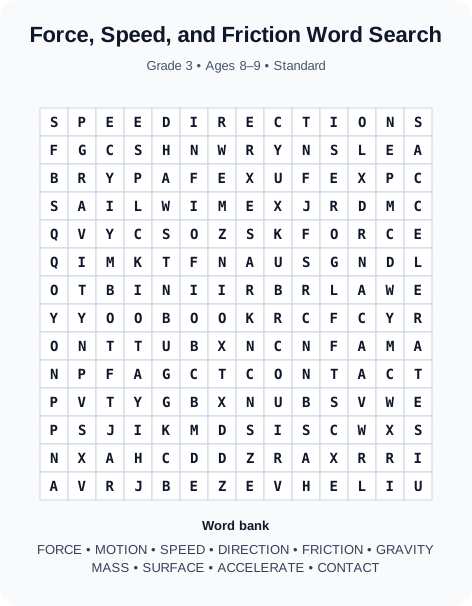
Force, Speed, and Friction Word Search
Build on the same science topic with another Grade 3 printable.
Continue learning