Properties of Matter Word Search
- Free
- No account
- Answer key
- Beginner
- About 15 min
- 12 words
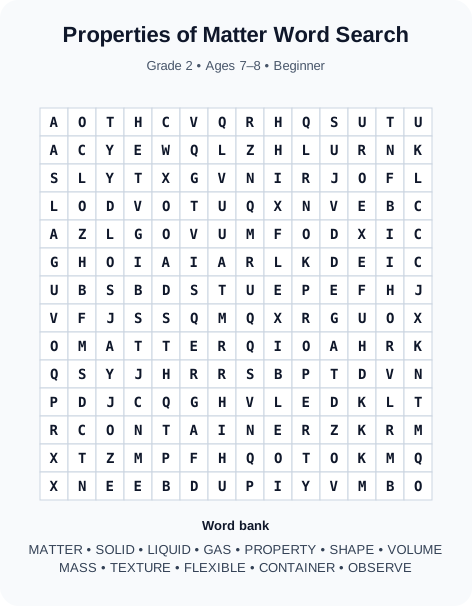
Build Grade 2 vocabulary about solids, liquids, and gases with a printable word search, exact definitions, and home observations.
For parents and caregivers
What your child will practice
- Classify familiar materials as solids, liquids, or gases using observable properties.
- Describe how matter can take up space and how a material can keep or change its shape.
- Use careful observations to compare the properties of two everyday materials.
How to use this puzzle at home
- Preview the word bank and invite your child to sort the terms into states, properties, and observation tools.
- Have your child find each hidden word, read its definition, and name one safe household example.
- Choose a solid and a liquid to observe together, recording their shape, texture, and container behavior.
Word List
- MATTER
- SOLID
- LIQUID
- GAS
- PROPERTY
- SHAPE
- VOLUME
- MASS
- TEXTURE
- FLEXIBLE
- CONTAINER
- OBSERVE
Printable Puzzle
Vocabulary guide
Use these short definitions before or after the word search. Ask your child to explain a few in their own words.
- Matter
- Anything that has mass and takes up space, including solids, liquids, and gases.
- Solid
- A state of matter that keeps its own shape and has a definite volume.
- Liquid
- A state of matter that flows and takes the shape of its container.
- Gas
- A state of matter that spreads out to fill the space available in a container.
- Property
- A characteristic of a material that can be observed or measured.
- Shape
- The outline or form of an object or material.
- Volume
- The amount of space that a material or object takes up.
- Mass
- The amount of matter in an object, measured with a balance.
- Texture
- How a material feels when someone touches its surface.
- Flexible
- Able to bend or change shape without breaking easily.
- Container
- An object that holds a material, such as a cup, jar, or box.
- Observe
- To gather information by using senses or tools carefully.
Talk about the science
- What evidence shows that a pencil is a solid even when it is moved to a new place?
- Why does water change shape when it is poured into a different container?
- How could a balance or another tool help you compare two materials?
Try one more thing
Extension activity
Design a mystery-material investigation with an adult. Examine three safe objects without tasting them, record texture, shape, and whether each flows, then use the evidence to classify and explain your choices.
Teacher and tutor note
Classroom adaptation
Set up stations with safe solids and liquids in closed, labeled containers. Partners solve the puzzle, then use a property chart to record observations, classify each sample, and explain which evidence supports the classification.
Keep learning
Same Grade
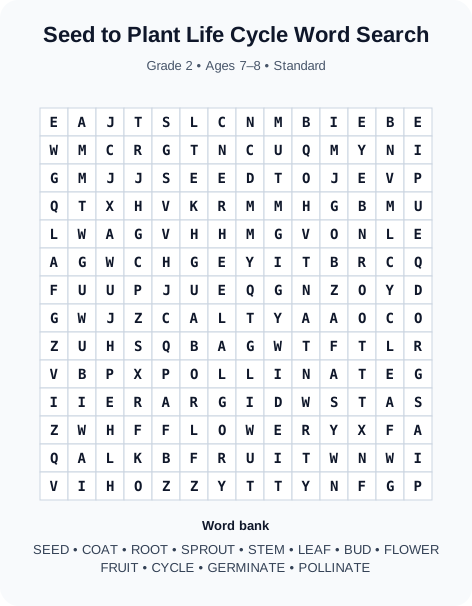
Seed to Plant Life Cycle Word Search
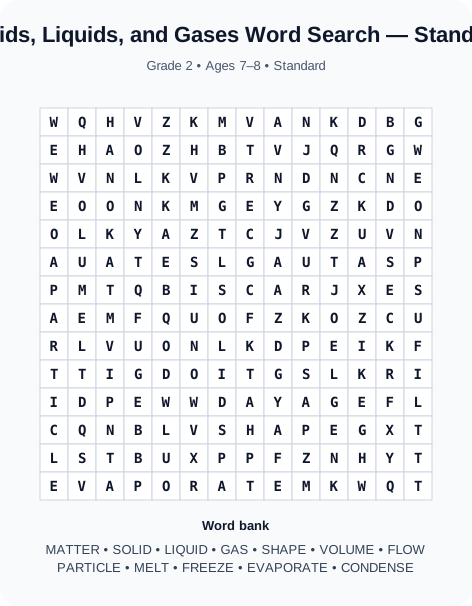
Continue with properties of matter
Ready for another puzzle?
Solids, Liquids, and Gases Word Search
Build on the same science topic with another Grade 2 printable.
Continue learning