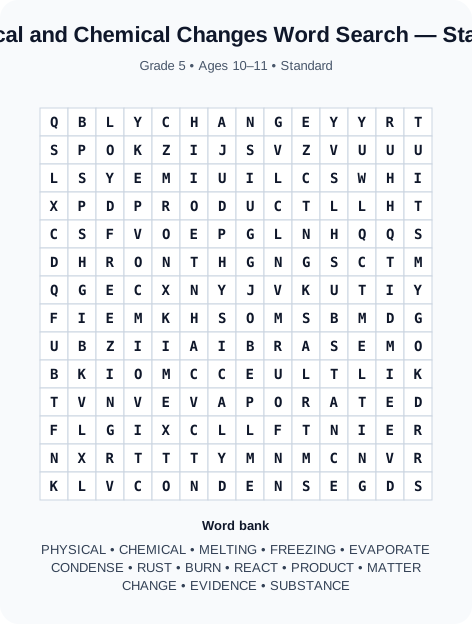
Physical and Chemical Changes Word Search
- Free
- No account
- Answer key
- Standard
- About 22 min
- 14 words
One printable file with the activity first and the answer key after it.
Choose the right level
Easy, Standard, or Challenge
Easy
8 words · About 13 min
Standard
14 words · About 22 min
Challenge
20 words · About 30 min
Download a free Grade 5 physical and chemical changes word search PDF with three levels, answer keys, definitions, and an evidence-sorting activity.
For parents and caregivers
What your child will practice
- Distinguish physical changes from chemical changes using evidence about substances and properties.
- Identify observations that may indicate a chemical reaction without treating any single sign as absolute proof.
How to use this puzzle at home
- Preview several safe examples and ask which observations suggest a new substance may have formed.
- Complete the selected puzzle level and check every term with its answer key.
- Sort example cards as physical change, chemical change, or not enough evidence and explain each choice.
What you need
- Printed worksheet or PDF viewer
- Pencil or highlighter
- Optional teacher-prepared change and evidence cards
Word List
- PHYSICAL
- CHEMICAL
- MELTING
- FREEZING
- EVAPORATE
- CONDENSE
- RUST
- BURN
- REACT
- PRODUCT
- MATTER
- CHANGE
- EVIDENCE
- SUBSTANCE
Printable Puzzle
Open Puzzle PDFOpen Answer KeyDownload Worksheet + Answer Key
Vocabulary guide
Use these short definitions before or after the word search. Ask your child to explain a few in their own words.
- Physical
- Describes a change in form or state that does not by itself create a new substance.
- Chemical
- Describes a change in which atoms rearrange and one or more new substances form.
- Melting
- A physical change from a solid state to a liquid state.
- Freezing
- A physical change from a liquid state to a solid state.
- Evaporate
- To undergo a physical change from liquid to gas at the surface.
- Condense
- To undergo a physical change from gas to liquid.
- Rust
- A substance formed when iron reacts with oxygen and usually water.
- Burn
- To react rapidly with oxygen and release energy as heat and often light.
- React
- To take part in a chemical change that rearranges atoms into different substances.
- Product
- A substance formed during a chemical reaction.
- Matter
- Anything that has mass and occupies space.
- Change
- A difference in form, state, composition, or other properties over time.
- Evidence
- Observations or measurements used to support an explanation or conclusion.
- Substance
- Matter with a consistent composition and characteristic properties.
- Boiling
- Rapid vaporization throughout a liquid when it reaches its boiling point.
- Oxidation
- A chemical process involving loss of electrons, often including reaction with oxygen.
- Reversible
- Describes a change that can be undone to recover the earlier material or state.
- Irreversible
- Describes a change that is difficult or impossible to undo under ordinary conditions.
- Reactant
- A starting substance that is changed during a chemical reaction.
- Precipitate
- A solid that forms from substances dissolved in a liquid during a reaction.
Talk about the science
- Why is a change of state usually classified as a physical change?
- What combinations of evidence make a chemical change more convincing?
- Why does reversible not always mean physical and irreversible not always mean chemical?
Quick check
Measurable exit ticket
Exit ticket: classify two physical and two chemical changes, identify the evidence used, and explain why melting is different from burning even though both can involve heating.
Try one more thing
Extension activity
Create an evidence table for six everyday changes. Record the starting material, observation, possible new substance, classification, and confidence level, then identify one example where additional evidence would improve the conclusion.
Teacher and tutor note
Classroom adaptation
After the puzzle, teams analyze observation cards from safe demonstrations. They classify each change, separate evidence from inference, and revise one answer after comparing temperature, gas, color, odor, precipitate, or property evidence.
Differentiation and accommodations
Extra support
Start with the Easy version and a two-column chart comparing same substance with new substance before sorting examples.
More challenge
Use the Challenge version and evaluate an ambiguous observation where more than one piece of evidence is needed to support a chemical change.
Access options
- Use photographs or narrated demonstrations instead of live reactions.
- Allow oral classification, speech-to-text, or movable evidence cards.
- Avoid demonstrations involving allergens, flames, strong odors, or unexpected sounds.
Accessibility
All terms, definitions, and instructions appear in selectable HTML with zoom and keyboard access. The PDFs are visually structured and untagged; optional demonstrations should always have narrated, image-based, and low-sensory alternatives without flames or strong odors.
Keep learning
Continue with matter
Ready for another puzzle?
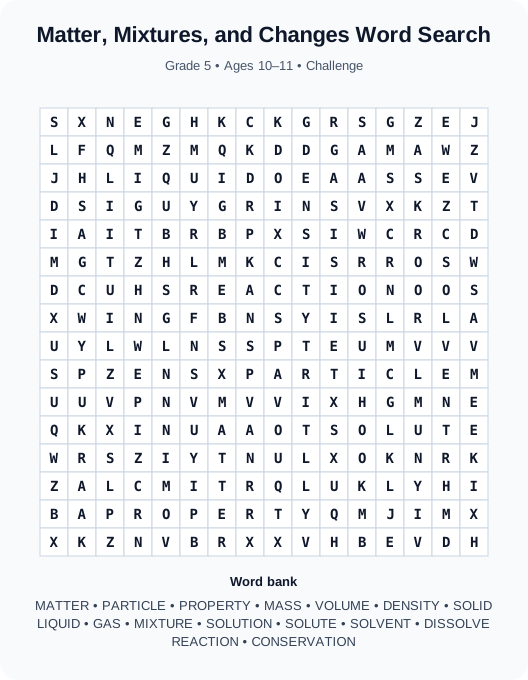
Matter, Mixtures, and Changes Word Search
Build on the same science topic with another Grade 5 printable.
Continue learning