Sun, Moon, and Star Patterns Word Search
- Free
- No account
- Answer key
- Beginner
- About 14 min
- 12 words
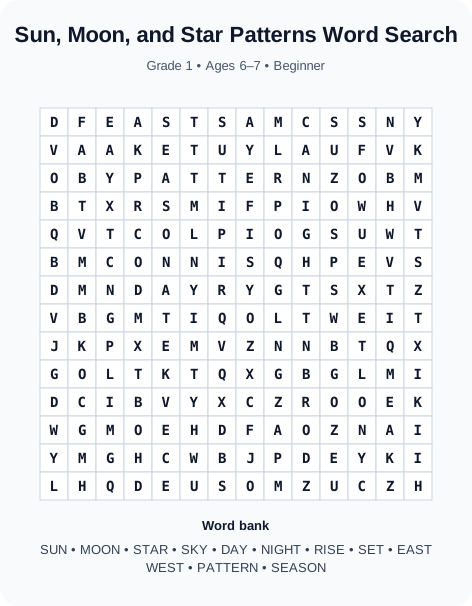
Notice repeating patterns of the Sun, Moon, stars, and daylight with a printable Grade 1 word search, accurate definitions, and safe sky observations.
For parents and caregivers
What your child will practice
- Identify words used to describe objects and events observed in the sky.
- Describe the repeating daily pattern of the Sun appearing to rise and set.
- Compare the amount of daylight at different times of year using recorded observations.
How to use this puzzle at home
- Read the word bank together and ask your child which objects can be seen during the day, at night, or both.
- Have your child circle the hidden words and check unfamiliar meanings in the definition list.
- At a safe time, observe the sky without looking directly at the Sun and record where the Sun appears relative to a landmark.
Word List
- SUN
- MOON
- STAR
- SKY
- DAY
- NIGHT
- RISE
- SET
- EAST
- WEST
- PATTERN
- SEASON
Printable Puzzle
Vocabulary guide
Use these short definitions before or after the word search. Ask your child to explain a few in their own words.
- Sun
- The star closest to Earth and the source of most daylight on our planet.
- Moon
- Earth's natural satellite, which travels around Earth and reflects sunlight.
- Star
- A huge sphere of hot gas that produces its own light and energy.
- Sky
- The view above Earth's surface where we see clouds and objects in space.
- Day
- The time when sunlight brightens the part of Earth where an observer is located.
- Night
- The time when an observer's part of Earth faces away from the Sun.
- Rise
- To appear above the horizon, as the Sun seems to do while Earth turns.
- Set
- To appear to move below the horizon, as the Sun seems to do while Earth turns.
- East
- The compass direction where the Sun appears to rise.
- West
- The compass direction where the Sun appears to set.
- Pattern
- An event or arrangement that repeats in a way that can be observed.
- Season
- One part of the year with a recurring pattern of daylight and weather.
Talk about the science
- What daily pattern do you notice in where the Sun seems to rise and set?
- Why can the Moon sometimes be visible during the day?
- How might the time of sunset change from one season to another?
Try one more thing
Extension activity
Keep a five-day sky journal with an adult. At the same safe time each day, sketch the sky and note daylight, clouds, and the Moon if visible; never look directly at the Sun. Compare the entries for patterns.
Teacher and tutor note
Classroom adaptation
Use the puzzle before a weeklong sky-pattern chart. Each day, students add safe observations of daylight, the Moon when visible, and the Sun's apparent position, then look for events that repeat.
Keep learning
Same Grade
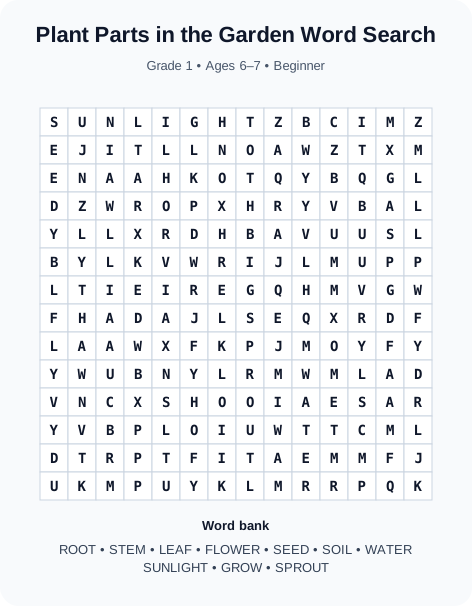
Plant Parts in the Garden Word Search
Keep learning at Grade 1
Ready for another puzzle?
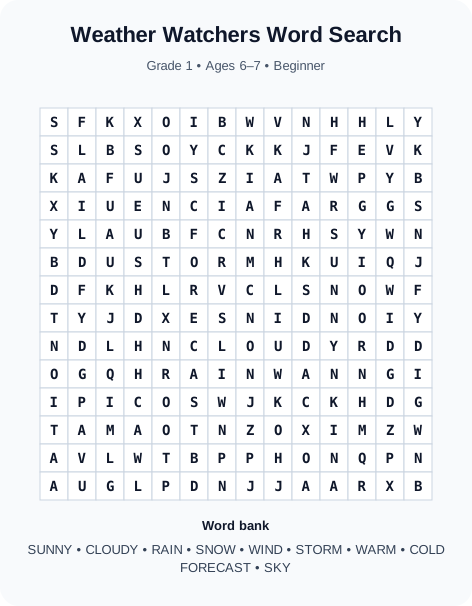
Weather Watchers Word Search
Continue with a different science topic at a familiar level.
Continue learning