Water Resources and Conservation Word Search
- Free
- No account
- Answer key
- Challenge
- About 24 min
- 16 words
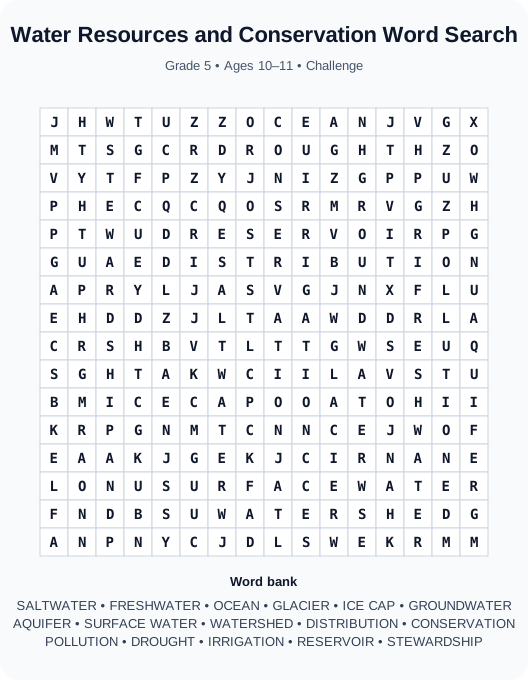
Explore where Earth's water is stored and how people can protect limited freshwater with definitions, an answer key, and a family water-use audit.
For parents and caregivers
What your child will practice
- Compare major stores of saltwater and freshwater on Earth.
- Explain why much of Earth's freshwater is not readily available for human use.
- Evaluate practical actions that conserve water and reduce pollution.
How to use this puzzle at home
- Preview the terms by sorting them into water stores, water uses, challenges, and actions people can take.
- Complete the puzzle and pause after every four words to explain how those terms relate to available freshwater.
- Walk through one normal day and list where your household uses water directly or indirectly.
- Check the puzzle with the answer key, then choose one realistic conservation step for your family to test this week.
Word List
- SALTWATER
- FRESHWATER
- OCEAN
- GLACIER
- ICE CAP
- GROUNDWATER
- AQUIFER
- SURFACE WATER
- WATERSHED
- DISTRIBUTION
- CONSERVATION
- POLLUTION
- DROUGHT
- IRRIGATION
- RESERVOIR
- STEWARDSHIP
Printable Puzzle
Vocabulary guide
Use these short definitions before or after the word search. Ask your child to explain a few in their own words.
- Saltwater
- Water containing many dissolved salts, found mainly in oceans and seas.
- Freshwater
- Water with very little dissolved salt, found in ice, groundwater, lakes, and rivers.
- Ocean
- A vast body of saltwater that holds most of the water on Earth.
- Glacier
- A large, long-lasting mass of ice that moves slowly over land.
- Ice cap
- A thick covering of ice over a broad land area that stores freshwater.
- Groundwater
- Water held below Earth's surface in spaces and cracks in soil and rock.
- Aquifer
- A layer of permeable rock or sediment that stores and carries groundwater.
- Surface water
- Water found above ground in rivers, lakes, streams, wetlands, and reservoirs.
- Watershed
- An area of land where all runoff drains to the same body of water.
- Distribution
- The way a resource is spread among different places or storage locations.
- Conservation
- The careful use and protection of natural resources to reduce waste.
- Pollution
- Harmful materials or energy added to the environment, making resources less safe.
- Drought
- A long period with much less precipitation than an area normally receives.
- Irrigation
- The planned supply of water to crops or soil to support plant growth.
- Reservoir
- A natural or human-made place where water is collected and stored for later use.
- Stewardship
- Responsible care of natural resources for people, other organisms, and the future.
Talk about the science
- Why can a planet covered mostly by water still have limited usable freshwater?
- How can pollution in one part of a watershed affect communities downstream?
- Which water-saving action could have the greatest effect at school, and what evidence supports your choice?
Try one more thing
Extension activity
Conduct a one-day household or classroom water-use audit. Group each use as essential, reducible, or avoidable, estimate where water could be saved, and create a conservation plan with one measurable goal.
Teacher and tutor note
Classroom adaptation
After solving, have teams represent 100 units of Earth's water with counters and use a teacher-provided distribution model to separate saltwater, frozen freshwater, groundwater, and surface water. Teams then propose one conservation action for a local use.
Keep learning
Keep learning at Grade 5
Ready for another puzzle?
Earth Systems and Water Cycle Word Search
Continue with a different science topic at a familiar level.
Continue learning