Weather, Climate, and Hazards Word Search
- Free
- No account
- Answer key
- Standard
- About 22 min
- 16 words
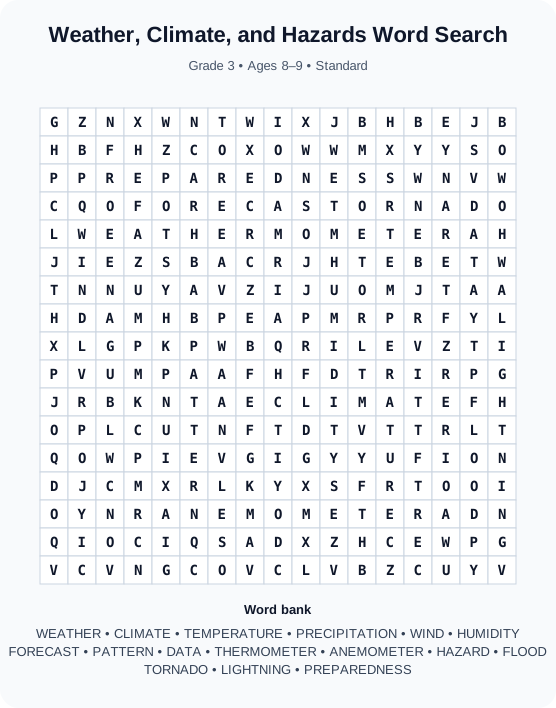
Study weather data, climate patterns, forecasting, and hazard safety with a Grade 3 printable word search, family activities, and answer key.
For parents and caregivers
What your child will practice
- Record and compare weather measurements to identify patterns over days or seasons.
- Distinguish short-term weather conditions from long-term climate patterns in a region.
- Explain how forecasts and preparedness actions can reduce the effects of weather hazards.
How to use this puzzle at home
- Check today's local conditions and ask your child which words describe observations, measurements, or predictions.
- Complete the puzzle, then use each definition to sort the words into weather, climate, tools, or hazards.
- Compare several days of temperatures or precipitation and look for a pattern without calling it climate.
- Review your household's trusted weather-alert source and one safe action for the most likely local hazard.
Word List
- WEATHER
- CLIMATE
- TEMPERATURE
- PRECIPITATION
- WIND
- HUMIDITY
- FORECAST
- PATTERN
- DATA
- THERMOMETER
- ANEMOMETER
- HAZARD
- FLOOD
- TORNADO
- LIGHTNING
- PREPAREDNESS
Printable Puzzle
Vocabulary guide
Use these short definitions before or after the word search. Ask your child to explain a few in their own words.
- Weather
- The condition of the atmosphere at a particular place and time.
- Climate
- The usual pattern of weather in a region measured over many years.
- Temperature
- A measurement of how hot or cold the air or another substance is.
- Precipitation
- Water that falls from clouds as rain, snow, sleet, or hail.
- Wind
- Air moving from one place to another, described by its speed and direction.
- Humidity
- A measure of the amount of water vapor present in the air.
- Forecast
- A prediction of future weather based on observations, patterns, and data.
- Pattern
- A change or event that repeats in a recognizable and predictable way.
- Data
- Measurements or observations collected so they can be studied and compared.
- Thermometer
- An instrument used to measure temperature.
- Anemometer
- An instrument used to measure the speed of wind.
- Hazard
- An event or condition that can cause harm to people, property, or the environment.
- Flood
- An overflow of water onto land that is usually dry.
- Tornado
- A violently rotating column of air that extends from a thunderstorm to the ground.
- Lightning
- A sudden electrical discharge in the atmosphere that produces a bright flash.
- Preparedness
- Planning and practicing safe actions before a possible hazard occurs.
Talk about the science
- Why does one unusually cold day not prove that a region has a cold climate?
- Which measurements would make tomorrow's weather forecast more useful?
- How can a weather pattern help people prepare for a hazard?
- Why should safety plans use trusted local guidance instead of one plan for every hazard?
Try one more thing
Extension activity
Create a seven-day weather-and-safety briefing. Record daily data, display at least one graph, describe a pattern, compare the week with a reliable climate summary, and add a clear preparedness step for one local hazard.
Teacher and tutor note
Classroom adaptation
Use the puzzle to launch a weeklong weather log. Teams measure or obtain temperature, wind, and precipitation data, graph a pattern, compare it with regional climate information, and propose one hazard-preparedness message.
Keep learning
Same Grade
Healthy Heart and Lungs Word Search
Related Topic
Seasonal Changes in Nature Word Search
Continue with weather, climate, and hazards
Ready for another puzzle?
Weather Science Tools Word Search
Build on the same science topic with another Grade 3 printable.
Continue learning