Weathering and Erosion Word Search
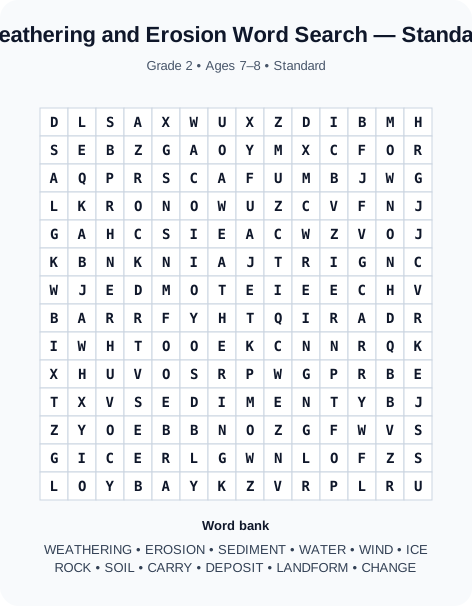
- Free
- No account
- Answer key
- Standard
- About 17 min
- 12 words
One printable file with the activity first and the answer key after it.
Download a free Grade 2 weathering and erosion word search PDF with an answer key, clear definitions, and a simple land-change investigation.
For parents and caregivers
What your child will practice
- Distinguish weathering that breaks material down from erosion that moves sediment.
- Identify water, wind, ice, and gravity as causes of changes to Earth's surface.
How to use this puzzle at home
- Preview the terms and compare a whole cracker or clump of soil with smaller loose pieces.
- Complete the puzzle and check the vocabulary with the answer key.
- Observe a safe outdoor surface or photograph and look for evidence that water or wind moved material.
What you need
- Printed worksheet or PDF viewer
- Pencil or highlighter
- Optional landform photographs or tray model
Word List
- WEATHERING
- EROSION
- SEDIMENT
- WATER
- WIND
- ICE
- ROCK
- SOIL
- CARRY
- DEPOSIT
- LANDFORM
- CHANGE
Printable Puzzle
Open Puzzle PDFOpen Answer KeyDownload Worksheet + Answer Key
Vocabulary guide
Use these short definitions before or after the word search. Ask your child to explain a few in their own words.
- Weathering
- The breaking of rock into smaller pieces at or near Earth's surface.
- Erosion
- The movement of weathered rock, soil, or sediment to another place.
- Sediment
- Loose pieces of rock, soil, or once-living material that can be moved and deposited.
- Water
- A liquid that can break down, carry, and deposit Earth materials.
- Wind
- Moving air that can carry small particles from one place to another.
- Ice
- Frozen water that can crack rock or move sediment as a glacier.
- Rock
- A naturally occurring solid material made of one or more minerals.
- Soil
- A mixture of mineral pieces, water, air, and organic material at Earth's surface.
- Carry
- To move material from one location toward another location.
- Deposit
- To drop or leave sediment in a new place after it has been moved.
- Landform
- A natural feature of Earth's surface, such as a hill, valley, or canyon.
- Change
- A difference in the shape, position, size, or condition of something over time.
Talk about the science
- How are weathering and erosion different?
- Where might moving water deposit sediment when it slows down?
- How could plant roots reduce erosion on a slope?
Quick check
Measurable exit ticket
Exit ticket: draw three panels showing rock breaking, sediment moving, and sediment being deposited. Label weathering, erosion, and deposition and identify the moving agent.
Try one more thing
Extension activity
Build or draw a simple hill and predict where water would carry sediment. Test the idea with a teacher-approved model or analyze a photo sequence, then record where weathering, erosion, and deposition occurred.
Teacher and tutor note
Classroom adaptation
After the puzzle, pairs examine before-and-after landform photographs or a tray model. They label evidence of weathering, erosion, and deposition and explain the sequence using at least three vocabulary words.
Differentiation and accommodations
Extra support
Use the phrase break, move, drop with three picture cards before introducing weathering, erosion, and deposition.
More challenge
Ask the learner to predict how vegetation, slope, or a barrier might change the amount of sediment moved by water.
Access options
- Provide labeled photographs and allow oral explanations.
- Use a larger grid and a reading guide strip.
- Replace a hands-on tray investigation with a narrated image sequence when needed.
Accessibility
Vocabulary and instructions are available as selectable HTML with browser zoom and keyboard access. The PDF grid is visual and untagged, so offer labeled photographs, verbal descriptions, or a tactile landform model for learners who need another representation.
Keep learning
Same Grade
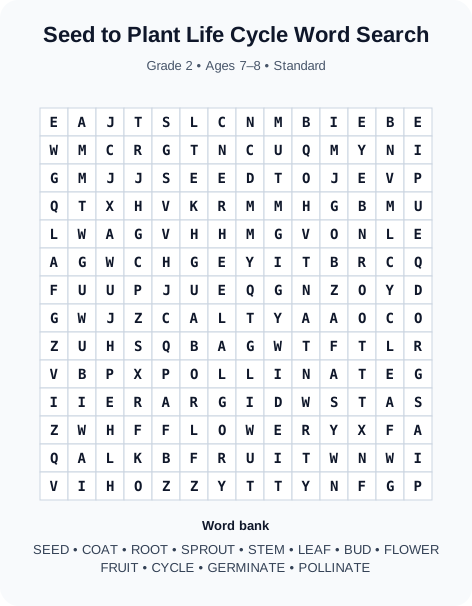
Seed to Plant Life Cycle Word Search
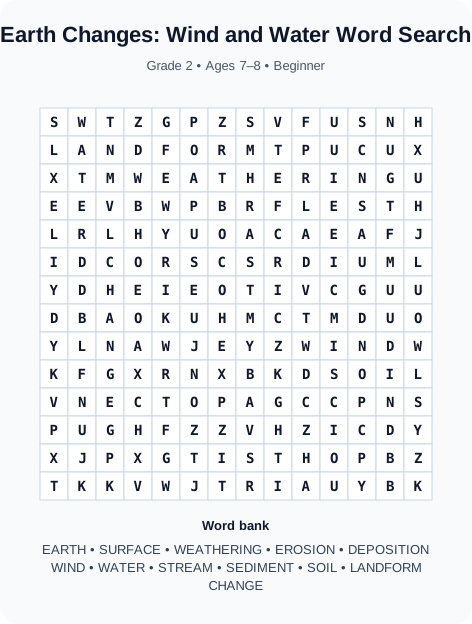
Continue with earth science
Ready for another puzzle?
Earth Changes: Wind and Water Word Search
Build on the same science topic with another Grade 2 printable.
Continue learning