Animal Sensing and Response Word Search
- Free
- No account
- Answer key
- Challenge
- About 22 min
- 16 words
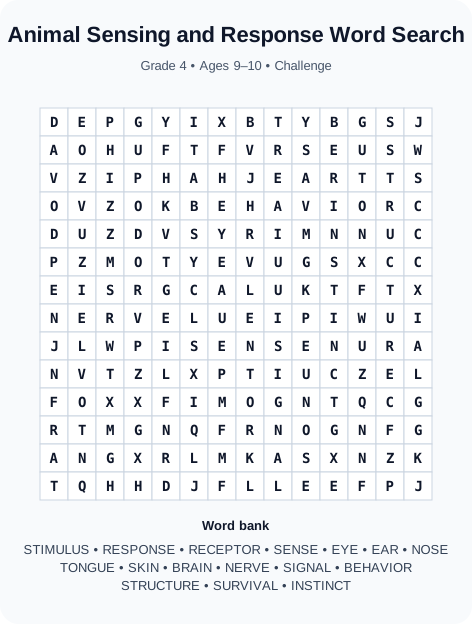
Follow information from sense receptors to the brain and an animal's response with a Grade 4 printable word search, investigations, and answer key.
For parents and caregivers
What your child will practice
- Model how sense receptors detect a stimulus and send information that leads to a response.
- Compare specialized structures animals use to obtain visual, auditory, chemical, or touch information.
- Explain how structures and behaviors help an animal survive, grow, or reproduce.
How to use this puzzle at home
- Preview the word bank and trace a simple sequence from stimulus to receptor, signal, brain, and response.
- Complete the puzzle, then match each sense organ with the kind of information its receptors detect.
- Safely observe a pet, bird, insect, or wildlife video and record one stimulus followed by a behavior.
- Discuss how the observed structure or response could help the animal find food, avoid danger, or communicate.
Word List
- STIMULUS
- RESPONSE
- RECEPTOR
- SENSE
- EYE
- EAR
- NOSE
- TONGUE
- SKIN
- BRAIN
- NERVE
- SIGNAL
- BEHAVIOR
- STRUCTURE
- SURVIVAL
- INSTINCT
Printable Puzzle
Vocabulary guide
Use these short definitions before or after the word search. Ask your child to explain a few in their own words.
- Stimulus
- A change inside or outside an organism that can be detected and may cause a response.
- Response
- An action or internal change that occurs after an organism detects a stimulus.
- Receptor
- A specialized cell or structure that detects a particular kind of stimulus.
- Sense
- An ability to receive information about conditions inside or outside the body.
- Eye
- A sense organ containing receptors that detect light and support vision.
- Ear
- A sense organ containing receptors that detect sound vibrations and body movement.
- Nose
- A structure containing receptors that detect airborne chemicals as smells.
- Tongue
- A mouth structure with receptors that detect certain chemicals dissolved in food or liquid.
- Skin
- An organ with receptors that can detect touch, pressure, temperature, and possible injury.
- Brain
- An organ that receives and processes information and helps coordinate responses.
- Nerve
- A bundle of fibers that carries signals between the brain, spinal cord, and body.
- Signal
- A message carried through the nervous system by electrical and chemical changes.
- Behavior
- An observable action an organism performs in response to internal or external conditions.
- Structure
- A body part with a form that helps it perform one or more functions.
- Survival
- The ability of an organism to remain alive under the conditions in its environment.
- Instinct
- An inherited behavior an animal can perform without first learning it.
Talk about the science
- Why can the same stimulus lead to different responses in two animals?
- How does the structure of a sense organ help it detect a particular kind of information?
- What role does the brain play between detecting a stimulus and producing a response?
- How might an inherited behavior improve an animal's chance of survival?
Try one more thing
Extension activity
Choose an animal with an unusual sensory structure, such as whiskers, antennae, large ears, or heat-sensing pits. Draw and label a stimulus-to-response model and explain with evidence how the structure supports survival.
Teacher and tutor note
Classroom adaptation
After the search, teams rotate through safe observation stations for light, sound, scent descriptions, and textured objects. Students model the information pathway with cards, then compare animal structures specialized for different stimuli.
Keep learning
Keep learning at Grade 4
Ready for another puzzle?
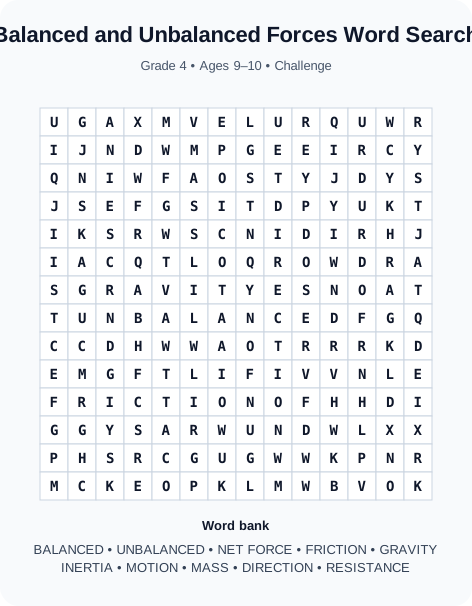
Balanced and Unbalanced Forces Word Search
Continue with a different science topic at a familiar level.
Continue learning