Free Human Body Word Search for 4th Grade
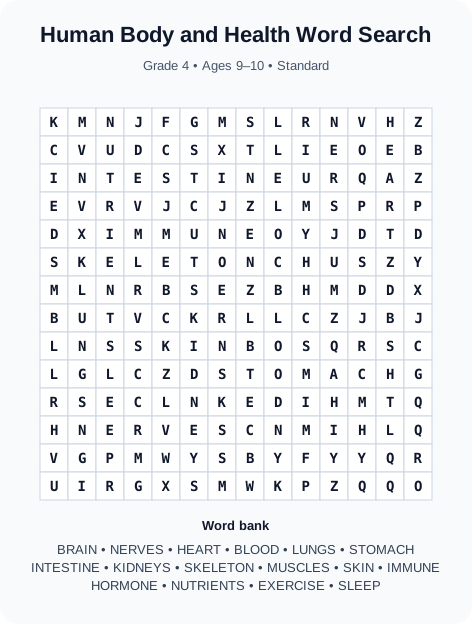
- Free
- No account
- Answer key
- Standard
- About 20 min
- 16 words
One printable file with the activity first and the answer key after it.
Choose the right level
Easy, Standard, or Challenge
Easy
10 words · About 12 min
Standard
16 words · About 20 min
Challenge
20 words · About 30 min
Download a free human body word search for 4th grade with 16 organ and body-system terms, a printable PDF, vocabulary definitions, and an answer key.
For parents and caregivers
What your child will practice
- Match selected organs and tissues with their main roles in major body systems.
- Explain with a simple model how two or more systems cooperate to deliver oxygen or nutrients and remove wastes.
- Describe everyday habits that can support body health without claiming that one habit prevents every illness.
How to use this puzzle at home
- Preview the word bank together and point to the approximate location of familiar organs on a simple body outline.
- Complete the word search, then read each definition and sort the words into body parts, messages or substances, and health habits.
- Choose one cooperation chain, such as lungs to blood to heart to muscles, and draw arrows showing what moves and what each part does.
- Finish with a one-minute teach-back in which your child explains one system connection and one habit that can support health.
What you need
- Printed worksheet or a PDF viewer
- Pencil, colored pencil, or highlighter
- Optional blank paper for a body-systems diagram
Word List
- BRAIN
- NERVES
- HEART
- BLOOD
- LUNGS
- STOMACH
- INTESTINE
- KIDNEYS
- SKELETON
- MUSCLES
- SKIN
- IMMUNE
- HORMONE
- NUTRIENTS
- EXERCISE
- SLEEP
Body systems at a glance
Use these groups to connect individual vocabulary words to the larger jobs body systems perform together.
Nervous system
The brain, nerves, and spine help receive information, carry signals, and coordinate responses.
Circulatory and respiratory systems
The heart, blood, lungs, and vessels work together to move oxygen and other materials.
Digestive and urinary systems
These parts process food and nutrients, balance fluids, and help remove wastes from the body.
Movement and protection
Bones, muscles, skin, and immune defenses support movement and help protect the body.
Body messages
Hormones are chemical messages that help coordinate processes such as growth and energy use.
Healthy routines
Exercise and sleep can support many body systems as part of an overall healthy routine.
Printable Puzzle
Open Puzzle PDFOpen Answer KeyDownload Worksheet + Answer Key
Vocabulary guide
Use these short definitions before or after the word search. Ask your child to explain a few in their own words.
- Brain
- An organ that processes information, coordinates many body functions, and exchanges signals through the nervous system.
- Nerves
- Bundles of fibers that carry signals between the brain, spinal cord, and the rest of the body.
- Heart
- A muscular organ that pumps blood through blood vessels to the lungs and the rest of the body.
- Blood
- A fluid tissue that carries oxygen and nutrients, transports some wastes, and helps defend and repair the body.
- Lungs
- Respiratory organs where oxygen enters the blood and carbon dioxide moves into air that is breathed out.
- Stomach
- A muscular digestive organ that stores and mixes food before it moves to the small intestine.
- Intestine
- Part of the digestive tract that absorbs nutrients and water and helps form solid waste.
- Kidneys
- Organs that filter blood, balance water and salts, and make urine from wastes and extra fluid.
- Skeleton
- The framework of bones that supports movement, protects organs, stores minerals, and contains marrow.
- Muscles
- Tissues that contract to move body parts and help organs such as the heart and digestive tract work.
- Skin
- The body's largest organ, forming a protective barrier, sensing conditions, and helping control temperature.
- Immune
- Describes the network of cells, tissues, and organs that responds to harmful microbes and damaged cells.
- Hormone
- A chemical messenger made by glands that travels through the body and helps regulate growth and energy use.
- Nutrients
- Substances obtained from food that the body uses for energy, growth, repair, and normal function.
- Exercise
- Physical activity that can strengthen muscles and bones and support heart, lung, and brain health.
- Sleep
- A natural period of rest that supports learning, memory, body repair, and healthy daily function.
- Spine
- A flexible column of bones called vertebrae that supports the body and protects the spinal cord.
- Liver
- An organ that processes nutrients, makes bile, stores energy, and helps remove harmful substances from blood.
- Bladder
- A muscular organ that stores urine made by the kidneys until it leaves the body.
- Vessels
- Tubes called arteries, veins, and capillaries that carry blood throughout the body.
Talk about the science
- How do the lungs, blood, and heart work together to bring oxygen to body cells?
- How do the brain, nerves, muscles, and skeleton cooperate when you choose to move?
- How can sleep and exercise support several body systems without guaranteeing that a person will never become ill?
Quick check
Measurable exit ticket
Exit ticket: name two body parts from different systems, state one accurate job for each, and use an arrow plus one sentence to explain what moves between them. A complete response identifies both parts, both jobs, and a scientifically reasonable connection.
Try one more thing
Extension activity
Make a Two Journeys Through the Body diagram. Trace oxygen from the lungs into the blood and toward working muscles, then trace nutrients from the intestine into the blood and toward body cells. Add the kidneys filtering wastes and extra fluid. Label at least eight vocabulary words and explain how the systems cooperate.
Teacher and tutor note
Classroom adaptation
In pairs, students place vocabulary cards on a large body outline, color-code them by body-system role, and add arrows to model how oxygen, nutrients, signals, or wastes move. Accept labeled drawings, oral explanations, or short writing, then close with an exit ticket naming two body parts and explaining how they work together.
Differentiation and accommodations
Extra support
Start with the Easy 10-word version, read the word bank aloud, and let the learner highlight each term before searching for it.
More challenge
Use the 20-word Challenge version, then ask the learner to create a four-step pathway showing how two or more body systems cooperate.
Access options
- Offer the searchable HTML word list and definitions alongside the visual grid.
- Allow oral answers, speech-to-text, a scribe, or a labeled drawing for the exit ticket.
- Print at a larger scale or use the browser zoom controls for learners who need larger text.
Accessibility
The page repeats the full word bank, instructions, and definitions as selectable HTML text and supports browser zoom and keyboard navigation. The visual word-search PDFs are not currently tagged for screen readers, so use the HTML vocabulary guide or provide a reader or scribe when needed.
Science sources
These authoritative references support the vocabulary descriptions and system connections on this page.
- MedlinePlus Health Topics: Body Locations and Systems — U.S. National Library of Medicine
- How the Lungs Work: The Respiratory System — National Heart, Lung, and Blood Institute
- Your Digestive System and How It Works — National Institute of Diabetes and Digestive and Kidney Diseases
- Your Kidneys and How They Work — National Institute of Diabetes and Digestive and Kidney Diseases
- Health Benefits of Physical Activity for Children — Centers for Disease Control and Prevention
Keep learning
Same Topic
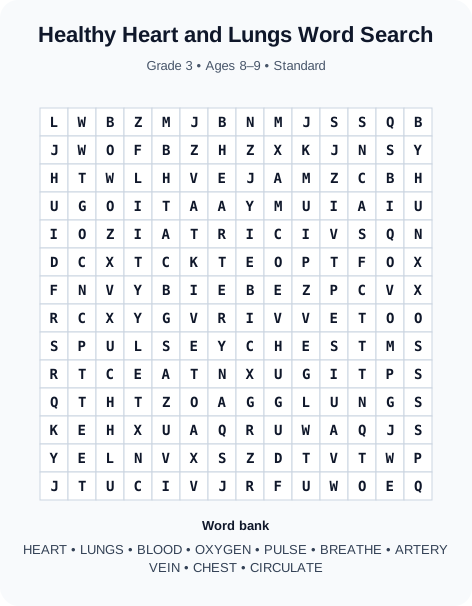
Healthy Heart and Lungs Word Search
Continue with human body
Ready for another puzzle?
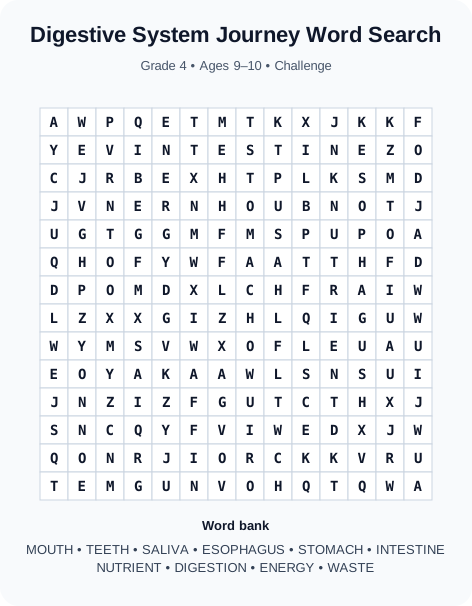
Digestive System Journey Word Search
Build on the same science topic with another Grade 4 printable.
Continue learning