Earth, Sun, and Moon Patterns Word Search
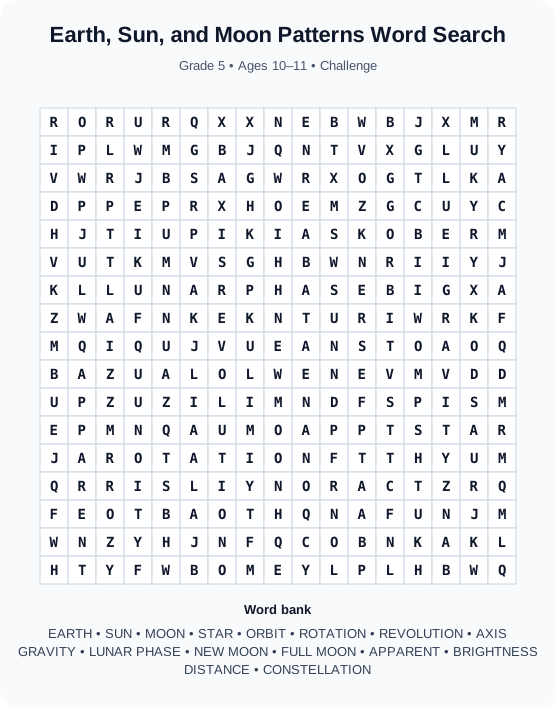
- Free
- No account
- Answer key
- Challenge
- About 25 min
- 16 words
Investigate orbits, lunar phases, and patterns in apparent brightness with accurate definitions, an answer key, and a scale-model activity for Grade 5.
For parents and caregivers
What your child will practice
- Use rotation and revolution to describe repeating Earth, Sun, and Moon patterns.
- Explain lunar phases as changing views of the Moon's sunlit half from Earth.
- Relate a star's apparent brightness to its actual light output and distance from Earth.
How to use this puzzle at home
- Preview the word bank and ask your child to separate objects, motions, forces, observations, and lunar phases.
- Complete the puzzle, then use the definitions to sketch one example of rotation and one example of revolution.
- Use a lamp and a ball to model the Moon's sunlit half, keeping the lamp still while the ball moves around the observer.
- Check with the answer key and ask your child to correct the common idea that Earth's shadow causes the regular lunar phases.
Word List
- EARTH
- SUN
- MOON
- STAR
- ORBIT
- ROTATION
- REVOLUTION
- AXIS
- GRAVITY
- LUNAR PHASE
- NEW MOON
- FULL MOON
- APPARENT
- BRIGHTNESS
- DISTANCE
- CONSTELLATION
Printable Puzzle
Vocabulary guide
Use these short definitions before or after the word search. Ask your child to explain a few in their own words.
- Earth
- The planet where we live, which rotates on its axis and revolves around the Sun.
- Sun
- The star at the center of our solar system and Earth's main source of light and heat.
- Moon
- Earth's natural satellite, which reflects sunlight and revolves around Earth.
- Star
- A huge sphere of hot gas that produces its own light and energy.
- Orbit
- The curved path one object follows around another object because of gravity.
- Rotation
- The spinning of an object around its axis, such as Earth's daily spin.
- Revolution
- One complete trip of an object around another object along an orbit.
- Axis
- An imaginary line through an object around which the object rotates.
- Gravity
- The attractive force between objects with mass that helps keep worlds in orbit.
- Lunar phase
- The changing shape of the Moon's sunlit portion that is visible from Earth.
- New moon
- The lunar phase when the Moon's sunlit half faces mostly away from Earth.
- Full moon
- The lunar phase when the Moon's sunlit half faces mostly toward Earth.
- Apparent
- Describing how something seems from a particular viewpoint rather than its actual size or motion.
- Brightness
- The amount of light an object appears to give off or reflect to an observer.
- Distance
- The amount of space between two objects, which can affect apparent brightness.
- Constellation
- A recognized pattern or region of stars as viewed from Earth.
Talk about the science
- How are rotation and revolution different, and what repeating patterns does each produce?
- Why do we see different lunar phases even though half of the Moon is always lit by the Sun?
- Why can the nearby Sun appear brighter than other stars that may produce more light?
Try one more thing
Extension activity
Create a scale-distance demonstration using one nearby light and one farther light. Record how apparent brightness changes with distance, then write a claim explaining why distance matters when comparing the Sun with other stars.
Teacher and tutor note
Classroom adaptation
After solving, organize students into Sun, Earth, Moon, and observer roles to model rotation, revolution, and lunar phases. Pause the model at new and full moon so students can describe the illuminated half from two viewpoints.
Keep learning
Related Topic
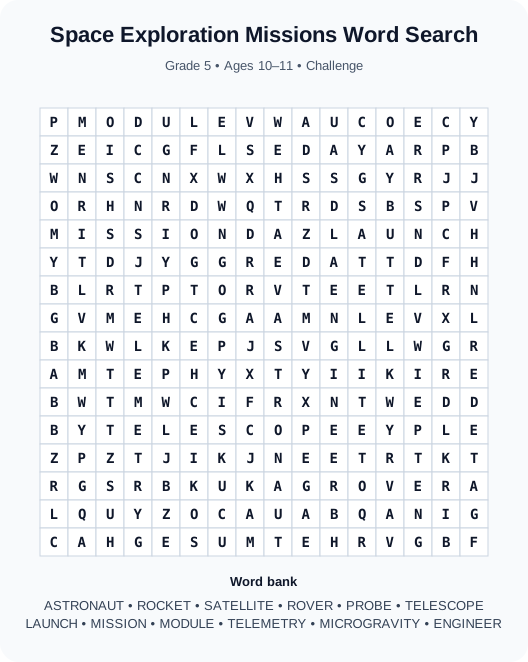
Space Exploration Missions Word Search
Keep learning at Grade 5
Ready for another puzzle?
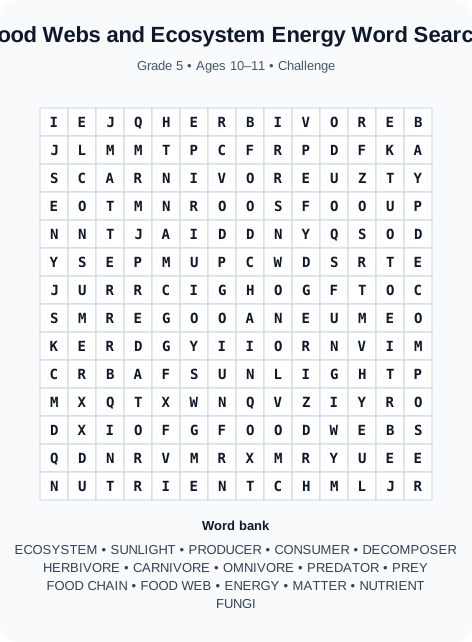
Food Webs and Ecosystem Energy Word Search
Continue with a different science topic at a familiar level.
Continue learning