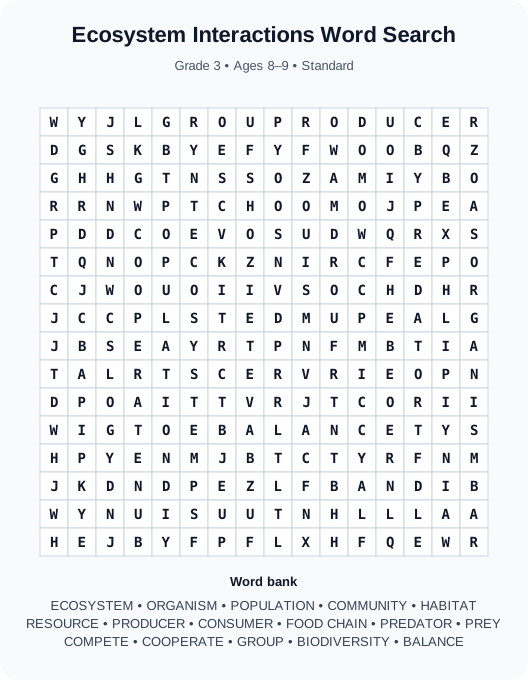
Ecosystem Interactions Word Search
- Free
- No account
- Answer key
- Standard
- About 21 min
- 16 words
Explore food chains, group behavior, competition, and biodiversity with a Grade 3 ecosystem word search, exact definitions, and answer key.
For parents and caregivers
What your child will practice
- Describe feeding, competition, and cooperation as interactions among organisms in an ecosystem.
- Explain how living in a group can help some animals obtain food, defend themselves, or raise young.
- Use evidence to predict how a habitat change could affect organisms and biodiversity.
How to use this puzzle at home
- Look over the words and ask your child to predict which terms name organisms, groups, needs, or interactions.
- After the word search, read the definitions together and sketch arrows for one simple food chain.
- Observe a nearby yard, park, or window view and list living things plus the resources they might use.
- Choose one imagined habitat change and discuss which population could benefit, struggle, or move away.
Word List
- ECOSYSTEM
- ORGANISM
- POPULATION
- COMMUNITY
- HABITAT
- RESOURCE
- PRODUCER
- CONSUMER
- FOOD CHAIN
- PREDATOR
- PREY
- COMPETE
- COOPERATE
- GROUP
- BIODIVERSITY
- BALANCE
Printable Puzzle
Vocabulary guide
Use these short definitions before or after the word search. Ask your child to explain a few in their own words.
- Ecosystem
- A system formed by living things and the nonliving environment interacting in an area.
- Organism
- An individual living thing, such as one plant, animal, fungus, or bacterium.
- Population
- All members of the same species living in the same area at the same time.
- Community
- All the different populations of living things that interact in an area.
- Habitat
- The place that provides an organism with food, water, shelter, and space.
- Resource
- Something in the environment that an organism needs, such as food, water, light, or space.
- Producer
- An organism, usually a plant or alga, that makes its own food using energy from light.
- Consumer
- An organism that gets energy by eating plants, animals, or other organisms.
- Food Chain
- A model showing one path along which food energy moves from one organism to another.
- Predator
- An animal that hunts, catches, and eats another animal for food.
- Prey
- An animal that is hunted and eaten by another animal.
- Compete
- To seek the same limited resource as another organism.
- Cooperate
- To act together in a way that helps members of a group meet a need.
- Group
- Two or more organisms living or acting together, sometimes increasing their chances of survival.
- Biodiversity
- The variety of living things found in an ecosystem or on Earth.
- Balance
- A condition in which ecosystem populations and resources remain within ranges that can be sustained.
Talk about the science
- How are a population and a community different?
- When might members of one species compete, and when might they cooperate?
- What could happen to a food chain if one population became much smaller?
- Why can an ecosystem with many kinds of organisms respond differently to change?
Try one more thing
Extension activity
Build an evidence map of a familiar ecosystem. Include at least six organisms, label producers and consumers, connect a food chain, show one competition or cooperation example, and predict one effect of losing a resource.
Teacher and tutor note
Classroom adaptation
Give small groups organism and resource cards from one local ecosystem. Students complete the puzzle, arrange a food chain, model competition for a limited resource, and explain how group behavior or biodiversity can support survival.
Keep learning
Same Grade
Healthy Heart and Lungs Word Search
Same Topic
Ecosystems and Biodiversity Word Search
Keep learning at Grade 3
Ready for another puzzle?
Force, Speed, and Friction Word Search
Continue with a different science topic at a familiar level.
Continue learning