Ecosystems and Biodiversity Word Search
- Free
- No account
- Answer key
- Beginner
- About 16 min
- 12 words
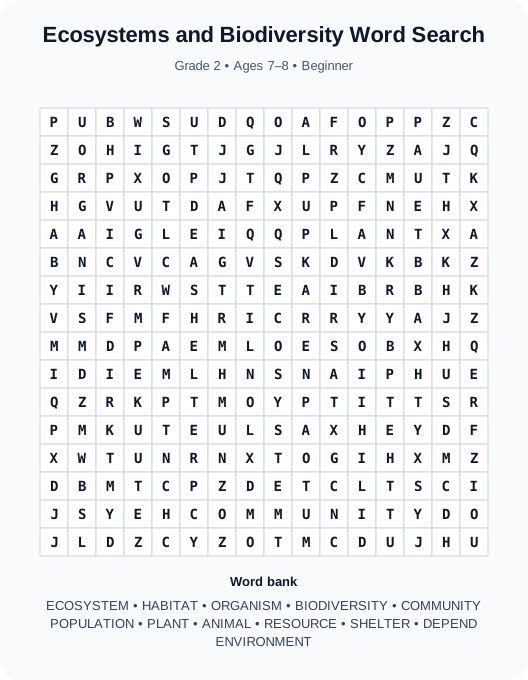
Explore Grade 2 vocabulary about habitats, living things, and biodiversity with a printable word search and family nature activities.
For parents and caregivers
What your child will practice
- Identify living and nonliving parts of a local ecosystem and describe their roles.
- Explain that plants and animals depend on their surroundings and on one another for needs.
- Use observations to compare biodiversity in two nearby habitats.
How to use this puzzle at home
- Read the words together and ask your child to sort them into living things, places, and needs.
- Have your child solve the puzzle, then use the definitions to describe one familiar habitat.
- Take a short, respectful outdoor walk and tally different plants, animals, and nonliving features.
Word List
- ECOSYSTEM
- HABITAT
- ORGANISM
- BIODIVERSITY
- COMMUNITY
- POPULATION
- PLANT
- ANIMAL
- RESOURCE
- SHELTER
- DEPEND
- ENVIRONMENT
Printable Puzzle
Vocabulary guide
Use these short definitions before or after the word search. Ask your child to explain a few in their own words.
- Ecosystem
- A community of living things and the nonliving parts of their environment.
- Habitat
- The place where an organism lives and finds what it needs to survive.
- Organism
- A living thing, such as a plant, animal, fungus, or tiny microbe.
- Biodiversity
- The variety of different living things found in a place.
- Community
- All the populations of living organisms that share an area.
- Population
- A group of organisms of the same kind living in one area.
- Plant
- A living organism that usually makes its own food using light energy.
- Animal
- A living organism that gets energy by eating plants or other animals.
- Resource
- Something an organism uses, such as food, water, shelter, or space.
- Shelter
- A place or structure that protects an organism from weather or danger.
- Depend
- To need or rely on something else for support or survival.
- Environment
- All the living and nonliving surroundings that affect an organism.
Talk about the science
- How does a plant depend on sunlight, water, and soil in its habitat?
- Why might a habitat with many kinds of organisms be more biodiverse than a lawn?
- What could happen to an animal if one resource in its environment became scarce?
Try one more thing
Extension activity
Build a mini habitat model from reused materials. Include at least two plants, two animals, and three nonliving features, then write labels explaining one way each organism depends on its environment.
Teacher and tutor note
Classroom adaptation
Create a classroom habitat map after students solve the puzzle. Small groups label living and nonliving features in a schoolyard or pond scene, draw arrows showing dependencies, and share evidence for why each feature belongs.
Keep learning
Same Grade
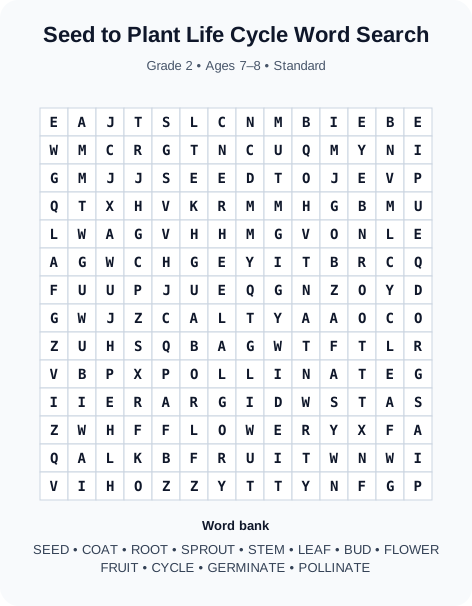
Seed to Plant Life Cycle Word Search
Try the next level
Ready for another puzzle?
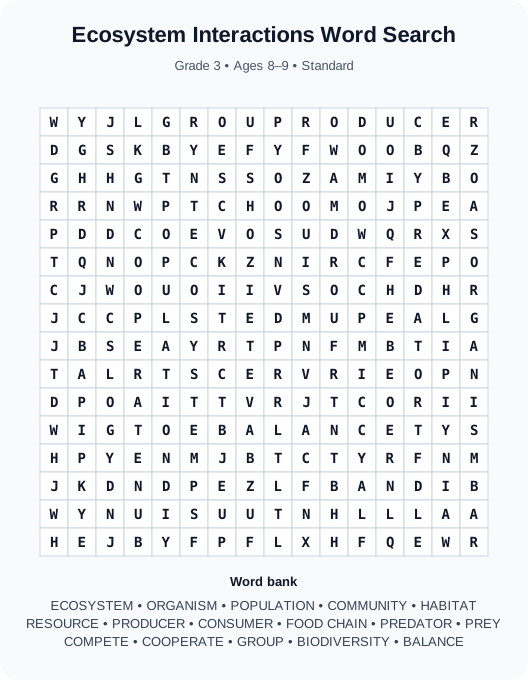
Ecosystem Interactions Word Search
Stay with ecosystems and biodiversity while moving up to Grade 3.
Continue learning