Exercise, Heart, and Lungs Word Search
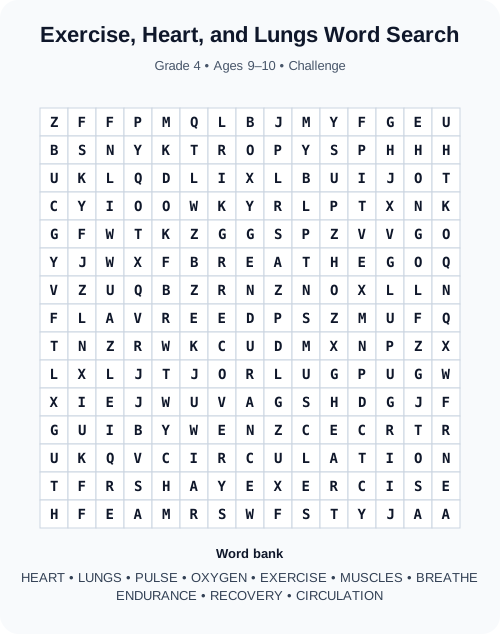
- Free
- No account
- Answer key
- Challenge
- About 18 min
- 10 words
A Grade 4 exercise puzzle with an answer key, body-system definitions, and a safe pulse observation for a home or classroom activity.
For parents and caregivers
What your child will practice
- Explain how the heart, lungs, blood, oxygen, and muscles work together during activity.
- Compare pulse and breathing observations before and after safe, self-paced movement.
How to use this puzzle at home
- Review the word bank and trace the path from breathing in oxygen to blood carrying it toward working muscles.
- Have your child complete the puzzle, then use five vocabulary words to explain what changes during exercise.
- Only try the extension with comfortable, self-paced movement, adult supervision, and any needed health accommodations.
Word List
- HEART
- LUNGS
- PULSE
- OXYGEN
- EXERCISE
- MUSCLES
- BREATHE
- ENDURANCE
- RECOVERY
- CIRCULATION
Printable Puzzle
Vocabulary guide
Use these short definitions before or after the word search. Ask your child to explain a few in their own words.
- Heart
- A muscular organ that pumps blood through vessels around the body.
- Lungs
- Organs where oxygen enters the blood and carbon dioxide leaves it.
- Pulse
- A rhythmic beat felt in an artery as the heart pumps blood.
- Oxygen
- A gas used by body cells to release energy from nutrients.
- Exercise
- Movement that challenges the body and can support physical fitness.
- Muscles
- Tissues that contract to move body parts and maintain posture.
- Breathe
- To move air into and out of the lungs during respiration.
- Endurance
- The ability to continue an activity for an extended period of time.
- Recovery
- The process of returning toward a resting state after activity.
- Circulation
- The continuous movement of blood through the heart, vessels, and body.
Talk about the science
- Why do breathing rate and pulse often increase during exercise?
- How does circulation connect the lungs with working muscles?
- What signs can tell a person to slow down, rest, or ask an adult for help?
Try one more thing
Extension activity
Observe breathing or count a pulse at rest, complete one minute of comfortable movement or a seated alternative, and observe again. Record the change and recovery without comparing results between people.
Teacher and tutor note
Classroom adaptation
Students complete the puzzle, annotate a simple heart-lungs-muscles flow diagram, and compare noncompetitive pulse or breathing observations before and after optional movement, with an equivalent seated choice.
Keep learning
Same Topic
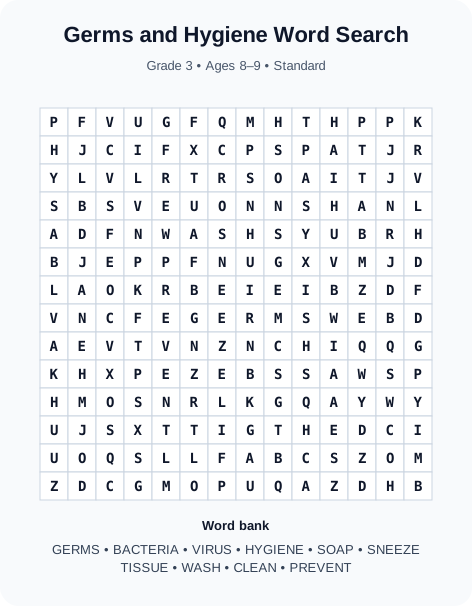
Germs and Hygiene Word Search
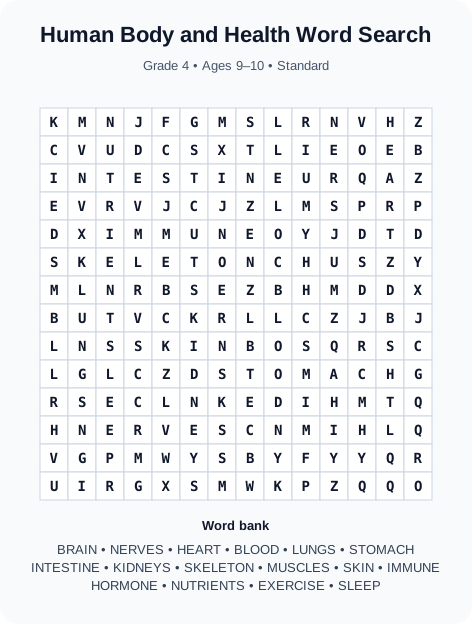
Keep learning at Grade 4
Ready for another puzzle?
Free Human Body Word Search for 4th Grade
Continue with a different science topic at a familiar level.
Continue learning