Forces and Motion Word Search
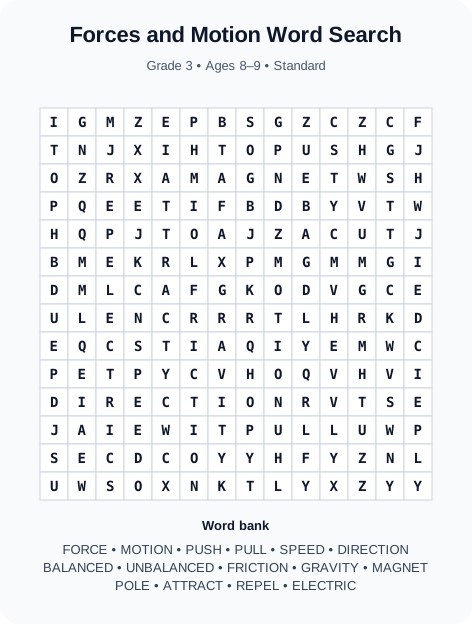
- Free
- No account
- Answer key
- Standard
- About 20 min
- 15 words
Build a complete Grade 3 picture of contact and noncontact forces with a printable word search, definitions, investigations, and answer key.
For parents and caregivers
What your child will practice
- Explain how balanced and unbalanced forces affect an object's motion.
- Use patterns in measured motion to predict how an object will move next.
- Compare contact forces with magnetic, electric, and gravitational forces that act at a distance.
How to use this puzzle at home
- Preview the word bank together and sort each term into motion, contact force, or force at a distance.
- Let your child complete the puzzle independently, then read every definition aloud and revisit any uncertain words.
- Slide the same small object across two safe surfaces and compare how friction changes its motion.
- Use two magnets to observe attraction and repulsion, keeping magnets away from electronics and small children.
Word List
- FORCE
- MOTION
- PUSH
- PULL
- SPEED
- DIRECTION
- BALANCED
- UNBALANCED
- FRICTION
- GRAVITY
- MAGNET
- POLE
- ATTRACT
- REPEL
- ELECTRIC
Printable Puzzle
Vocabulary guide
Use these short definitions before or after the word search. Ask your child to explain a few in their own words.
- Force
- A push or pull that can change an object's motion or shape.
- Motion
- A change in an object's position compared with a reference point over time.
- Push
- A force that moves an object away from the source of the force.
- Pull
- A force that moves an object toward the source of the force.
- Speed
- A measure of how far an object travels in a certain amount of time.
- Direction
- The course or path along which an object moves or points.
- Balanced
- Describes forces that are equal in strength and opposite in direction, causing no change in motion.
- Unbalanced
- Describes forces whose combined effect changes an object's speed or direction.
- Friction
- A contact force that resists motion between surfaces touching each other.
- Gravity
- A noncontact force of attraction between objects with mass, such as Earth and a ball.
- Magnet
- An object that produces a magnetic field and can attract or repel certain materials.
- Pole
- Either end of a magnet, called north or south, where its magnetic effect is strongest.
- Attract
- To pull objects toward one another through a force such as magnetism.
- Repel
- To push objects away from one another through a force such as magnetism.
- Electric
- Describes a force caused by electric charges that can attract or repel without touching.
Talk about the science
- How can an object stay still even when two forces are acting on it?
- What motion pattern would help you predict where a rolling ball will be next?
- How are magnetic attraction and magnetic repulsion alike and different?
- Which evidence shows that a force acted even when two objects did not touch?
Try one more thing
Extension activity
Plan a fair investigation of one force question. Change only the ramp height, surface, or magnet distance; measure three trials; display the results; and use the pattern as evidence for a motion prediction.
Teacher and tutor note
Classroom adaptation
After the search, rotate teams through a ramp, a surface-friction test, and a magnet station. Students record evidence, label each force as contact or noncontact, and explain one motion pattern to the class.
Keep learning
Same Grade
Healthy Heart and Lungs Word Search
Continue with forces and motion
Ready for another puzzle?
Magnets and Magnetic Forces Word Search
Build on the same science topic with another Grade 3 printable.
Continue learning