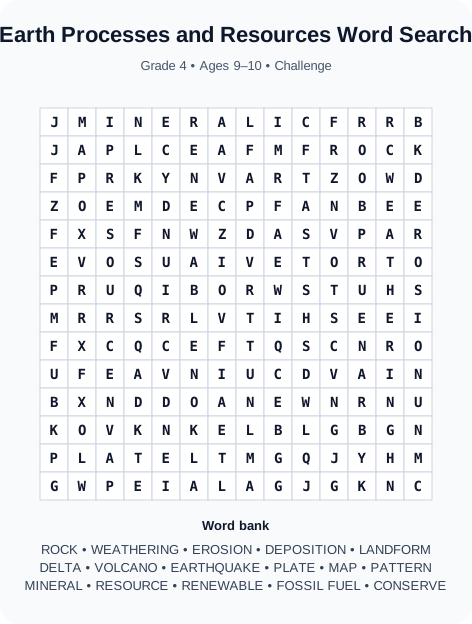
Earth Processes and Resources Word Search
- Free
- No account
- Answer key
- Challenge
- About 24 min
- 16 words
Connect weathering, erosion, landforms, plate patterns, minerals, and resource choices with a Grade 4 word search, activities, and answer key.
For parents and caregivers
What your child will practice
- Explain how weathering, erosion, and deposition change Earth's surface over time.
- Use maps to identify patterns in landforms, earthquakes, volcanoes, and plate locations.
- Compare renewable and nonrenewable resources and describe effects of obtaining or using them.
How to use this puzzle at home
- Preview the terms and ask your child which describe surface changes, map evidence, or natural resources.
- Complete the search, read every definition, and sketch weathering, erosion, and deposition in one scene.
- Examine a safe rock sample or photograph and distinguish the rock from the minerals within it.
- List three resources your household uses and discuss whether each is renewable or nonrenewable and why.
Word List
- ROCK
- WEATHERING
- EROSION
- DEPOSITION
- LANDFORM
- DELTA
- VOLCANO
- EARTHQUAKE
- PLATE
- MAP
- PATTERN
- MINERAL
- RESOURCE
- RENEWABLE
- FOSSIL FUEL
- CONSERVE
Printable Puzzle
Vocabulary guide
Use these short definitions before or after the word search. Ask your child to explain a few in their own words.
- Rock
- A naturally formed solid mixture of one or more minerals or mineral-like materials.
- Weathering
- The breaking down of rock at or near Earth's surface without moving it to a new place.
- Erosion
- The movement of weathered rock and soil by water, wind, ice, or gravity.
- Deposition
- The settling and accumulation of sediment after it has been transported.
- Landform
- A natural feature of Earth's surface, such as a mountain, valley, canyon, or plain.
- Delta
- A landform made from sediment deposited where a river enters a larger body of water.
- Volcano
- An opening in Earth's crust through which molten rock, gases, and ash may erupt.
- Earthquake
- Sudden ground shaking caused by a rapid release of energy when rocks move.
- Plate
- A large, rigid section of Earth's outer layer that moves slowly over time.
- Map
- A scaled representation that shows locations, features, or data patterns on Earth's surface.
- Pattern
- A repeated or organized arrangement in observations or data that can support an explanation.
- Mineral
- A naturally occurring, nonliving solid with a definite chemical composition and crystal structure.
- Resource
- A material or energy source from nature that people use to meet needs and wants.
- Renewable
- Describes a resource replaced naturally fast enough to be used again on a human timescale.
- Fossil Fuel
- Coal, oil, or natural gas formed from ancient organisms over millions of years.
- Conserve
- To protect a resource and reduce waste through careful, efficient use.
Talk about the science
- How do weathering, erosion, and deposition work together to reshape a landform?
- What map pattern might suggest a relationship among plates, earthquakes, and volcanoes?
- Why can two places use different natural resources to meet the same need?
- How can conserving a resource reduce environmental effects beyond simply saving money?
Try one more thing
Extension activity
Create a cause-and-evidence poster for one landscape. Show how at least two Earth processes formed or changed it, add a map pattern that supports the explanation, and evaluate one nearby natural resource use and conservation step.
Teacher and tutor note
Classroom adaptation
After the puzzle, teams use stream-table images or a simple sand-and-water model to sequence weathering, erosion, and deposition. They then interpret a plate-boundary map and evaluate one local resource choice.
Keep learning
Continue with earth processes and resources
Ready for another puzzle?
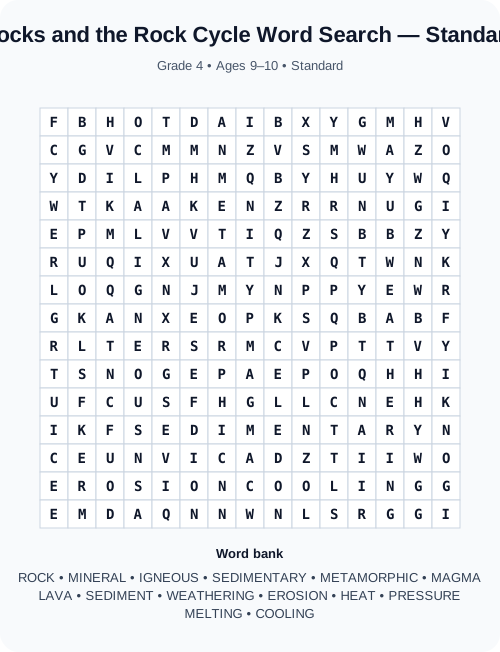
Rocks and the Rock Cycle Word Search
Build on the same science topic with another Grade 4 printable.
Continue learning