Sun, Moon, and Sky Word Search
- Free
- No account
- Answer key
- Beginner
- About 14 min
- 10 words
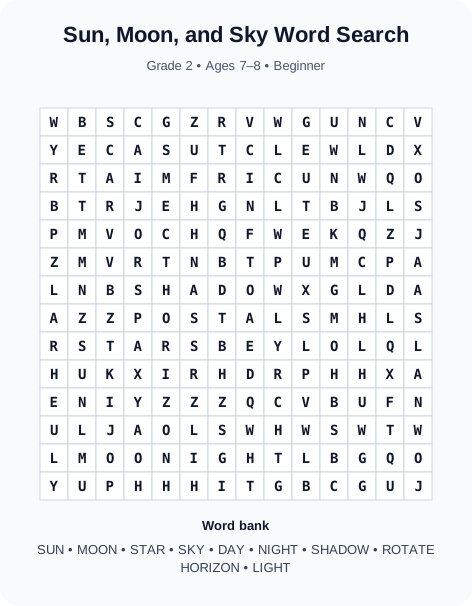
Explore daytime and nighttime skies with a printable Grade 2 word search, answer key, clear definitions, and a family observation activity.
For parents and caregivers
What your child will practice
- Describe objects and patterns that can be observed in the day and night sky.
- Explain that Earth rotates, creating the repeating pattern of day and night.
How to use this puzzle at home
- Ask your child to sort the word bank into things seen mostly in daytime or nighttime.
- Complete the puzzle together and pause to read the meaning of each newly found word.
- Observe the sky safely at two different times and compare the light, shadows, and visible objects.
Word List
- SUN
- MOON
- STAR
- SKY
- DAY
- NIGHT
- SHADOW
- ROTATE
- HORIZON
- LIGHT
Printable Puzzle
Vocabulary guide
Use these short definitions before or after the word search. Ask your child to explain a few in their own words.
- Sun
- The star closest to Earth that provides our planet with light and heat.
- Moon
- Earth's natural satellite, which reflects light from the Sun.
- Star
- A huge glowing ball of hot gas that produces its own light.
- Sky
- The space seen above Earth where the Sun, Moon, stars, and clouds appear.
- Day
- The time when a location on Earth faces toward the Sun and receives light.
- Night
- The darker time when a location on Earth faces away from the Sun.
- Shadow
- A dark shape formed when an object blocks light traveling from a source.
- Rotate
- To spin around a center point or axis, as Earth does once each day.
- Horizon
- The distant line where the land or ocean seems to meet the sky.
- Light
- Energy that travels and allows our eyes to see objects and colors.
Talk about the science
- Why does the Moon seem bright even though it is not a star?
- How does your shadow change when the Sun appears lower in the sky?
- What repeating sky pattern helps people organize each day?
Try one more thing
Extension activity
Make a two-column sky journal for one day. With an adult, draw the daytime sky and the nighttime sky, then label at least three differences using words from the puzzle.
Teacher and tutor note
Classroom adaptation
Use the puzzle before modeling Earth's rotation with a globe and lamp. Partners can sort vocabulary cards into day, night, or both, then explain where each card belongs.
Keep learning
Same Grade
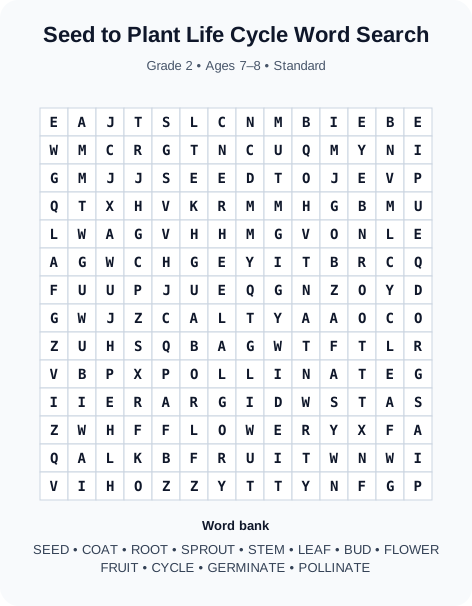
Seed to Plant Life Cycle Word Search
Related Topic
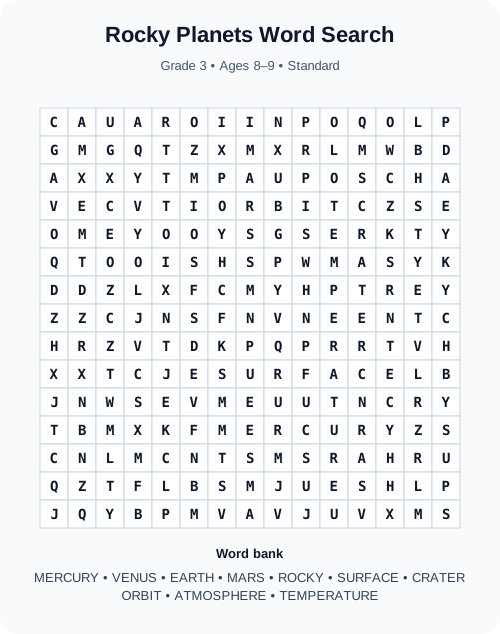
Rocky Planets Word Search
Keep learning at Grade 2
Ready for another puzzle?
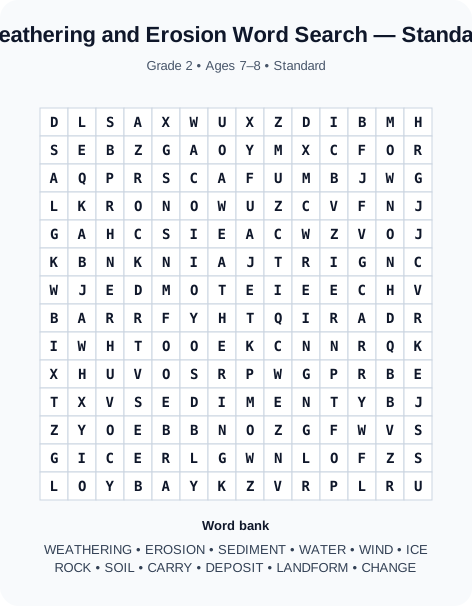
Weathering and Erosion Word Search
Continue with a different science topic at a familiar level.
Continue learning