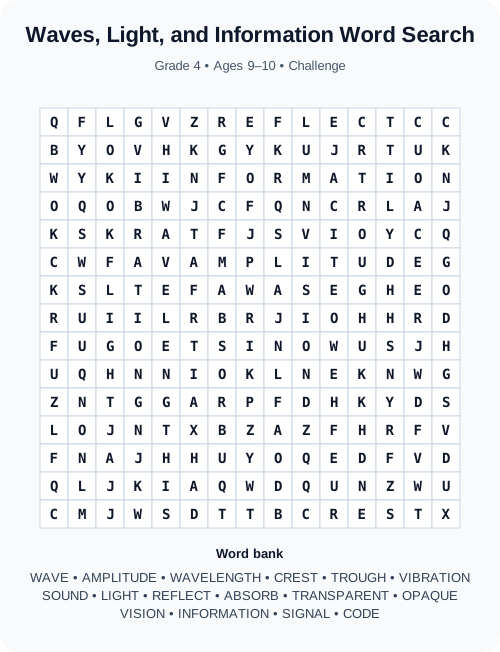
Waves, Light, and Information Word Search
- Free
- No account
- Answer key
- Challenge
- About 24 min
- 16 words
Link wave patterns, reflected light, vision, signals, and coded messages with a Grade 4 printable word search, activities, and answer key.
For parents and caregivers
What your child will practice
- Use amplitude and wavelength to describe repeating patterns in a model of a wave.
- Explain that objects are seen when light reflected from them enters an observer's eyes.
- Compare ways patterned signals and codes carry information from a sender to a receiver.
How to use this puzzle at home
- Preview the vocabulary and sort terms into wave parts, light behavior, seeing, or communication.
- After the puzzle, draw and label two waves with different amplitudes or wavelengths.
- Use a flashlight with adult supervision to compare reflection from a mirror, paper, and dark fabric without shining light into eyes.
- Create a short message with an agreed pattern of taps or flashes, then test whether a family member can decode it.
Word List
- WAVE
- AMPLITUDE
- WAVELENGTH
- CREST
- TROUGH
- VIBRATION
- SOUND
- LIGHT
- REFLECT
- ABSORB
- TRANSPARENT
- OPAQUE
- VISION
- INFORMATION
- SIGNAL
- CODE
Printable Puzzle
Vocabulary guide
Use these short definitions before or after the word search. Ask your child to explain a few in their own words.
- Wave
- A repeating disturbance that transfers energy from one place to another.
- Amplitude
- The maximum distance a wave moves from its resting position; greater amplitude means more energy.
- Wavelength
- The distance between matching points on neighboring waves, such as crest to crest.
- Crest
- The highest point of a transverse wave above its resting position.
- Trough
- The lowest point of a transverse wave below its resting position.
- Vibration
- A rapid back-and-forth motion that can create waves, including sound waves.
- Sound
- Energy carried by vibrations traveling through matter such as air, water, or solids.
- Light
- A form of energy that travels as electromagnetic waves and makes vision possible.
- Reflect
- To bounce light or another wave away from a surface.
- Absorb
- To take in light or another form of energy instead of reflecting or transmitting it.
- Transparent
- Describes a material that transmits most visible light so objects behind it can be seen clearly.
- Opaque
- Describes a material that does not transmit visible light through it.
- Vision
- The process of seeing when light entering the eyes is detected and interpreted by the brain.
- Information
- Facts, ideas, or instructions that can be represented and communicated.
- Signal
- A sound, light, electrical pattern, or other change used to carry information.
- Code
- A system of agreed symbols or patterns used to represent and communicate information.
Talk about the science
- How can two waves have the same wavelength but different amplitudes?
- Why can you see a book in a lit room but not in a completely dark room?
- What happens to light at transparent, opaque, reflective, and absorbing materials?
- What must a sender and receiver share for a coded signal to communicate information?
Try one more thing
Extension activity
Design a communication test using a sequence of colored cards, sounds, or safe flashlight pulses. Define the code, send three messages across the room, record decoding accuracy, and revise one feature to reduce errors.
Teacher and tutor note
Classroom adaptation
Use a rope or spring to model amplitude and wavelength after students complete the search. Then teams test light on several materials and design a patterned sound or light signal that reliably communicates a short message.
Keep learning
Keep learning at Grade 4
Ready for another puzzle?
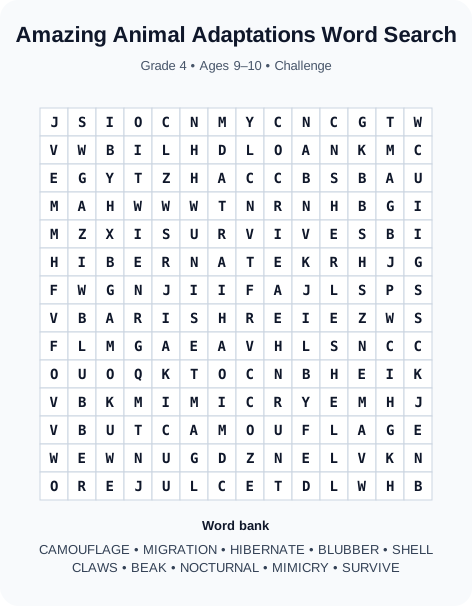
Amazing Animal Adaptations Word Search
Continue with a different science topic at a familiar level.
Continue learning