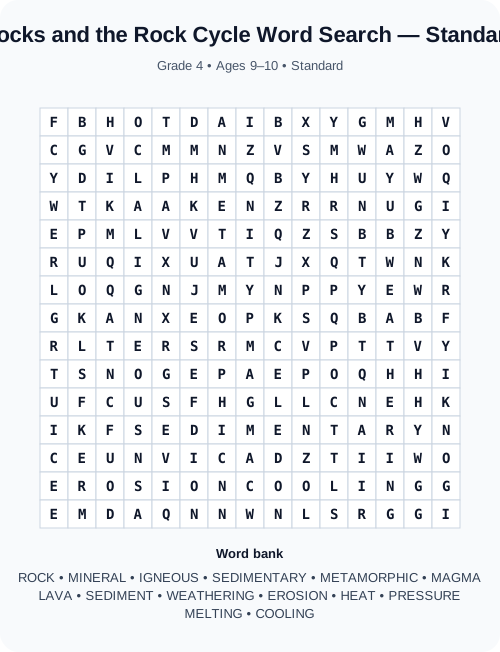
Rocks and the Rock Cycle Word Search
- Free
- No account
- Answer key
- Standard
- About 20 min
- 14 words
One printable file with the activity first and the answer key after it.
Download a free Grade 4 rock cycle word search PDF with an answer key, definitions, a process model, and a hands-on classification activity.
For parents and caregivers
What your child will practice
- Compare igneous, sedimentary, and metamorphic rocks using how each type forms.
- Model rock-cycle processes including weathering, erosion, heat, pressure, melting, and cooling.
How to use this puzzle at home
- Preview the three rock types and look closely at safe rock samples or photographs.
- Complete the word search and verify each term with the answer key.
- Draw arrows between rock types and label at least four processes that could cause change.
What you need
- Printed worksheet or PDF viewer
- Pencil or colored arrows
- Optional rock samples or detailed photographs
Word List
- ROCK
- MINERAL
- IGNEOUS
- SEDIMENTARY
- METAMORPHIC
- MAGMA
- LAVA
- SEDIMENT
- WEATHERING
- EROSION
- HEAT
- PRESSURE
- MELTING
- COOLING
Printable Puzzle
Open Puzzle PDFOpen Answer KeyDownload Worksheet + Answer Key
Vocabulary guide
Use these short definitions before or after the word search. Ask your child to explain a few in their own words.
- Rock
- A naturally occurring solid material made of one or more minerals.
- Mineral
- A naturally occurring inorganic solid with a characteristic composition and structure.
- Igneous
- A rock type formed when magma or lava cools and becomes solid.
- Sedimentary
- A rock type formed when sediment is compacted and cemented or material precipitates.
- Metamorphic
- A rock changed by heat, pressure, or fluids without completely melting.
- Magma
- Molten or partly molten rock located beneath Earth's surface.
- Lava
- Molten rock that has reached Earth's surface.
- Sediment
- Loose particles of rock, minerals, or once-living material.
- Weathering
- Processes that break rock into smaller pieces or alter its minerals.
- Erosion
- The movement of weathered material from one location to another.
- Heat
- Transfer of thermal energy that can contribute to melting or metamorphic change.
- Pressure
- Force applied over an area that can help transform buried rock.
- Melting
- A process in which solid rock gains enough energy to become molten material.
- Cooling
- A loss of thermal energy that can cause magma or lava to become solid rock.
Talk about the science
- Why can the same rock material become different rock types over a long time?
- How are magma and lava related but different?
- Why does the rock cycle have many possible pathways?
Quick check
Measurable exit ticket
Exit ticket: choose one rock type and trace two possible changes that could eventually produce a different type. Label each process and explain why the model represents a cycle rather than a fixed sequence.
Try one more thing
Extension activity
Create a rock-cycle story that follows one piece of matter through at least five processes. Include two rock types, label every transition, and explain where energy or moving water contributes to the changes.
Teacher and tutor note
Classroom adaptation
After the puzzle, groups examine labeled rock photographs or samples and use formation evidence to sort them. They then arrange process cards into more than one valid path through the rock cycle and explain why the cycle has no single starting point.
Differentiation and accommodations
Extra support
Provide a three-column formation chart and picture cards before asking the learner to draw cycle arrows.
More challenge
Ask the learner to create two different valid paths from sedimentary rock to igneous rock and compare them.
Access options
- Offer large photographs, tactile rock samples, and verbal descriptions.
- Allow movable process cards instead of requiring a hand-drawn diagram.
- Use color and text labels together so meaning does not depend on color alone.
Accessibility
Every term and instruction is available in selectable HTML with keyboard and zoom support. The PDF and rock photographs are primarily visual, so provide tactile samples, detailed descriptions, and movable labeled cards for learners who need nonvisual access.
Keep learning
Continue with earth science
Ready for another puzzle?
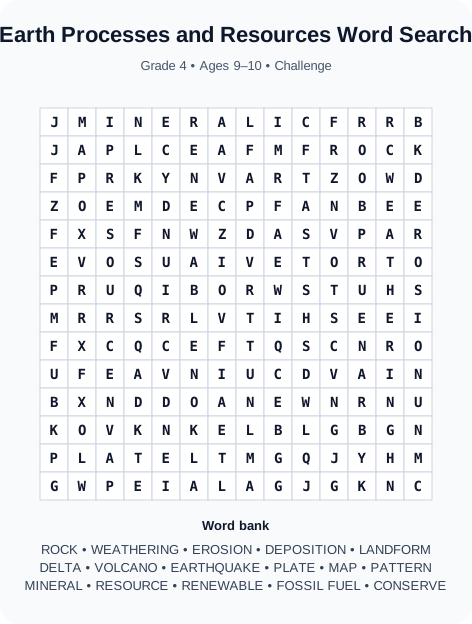
Earth Processes and Resources Word Search
Build on the same science topic with another Grade 4 printable.
Continue learning