Energy Transfer Word Search
- Free
- No account
- Answer key
- Challenge
- About 23 min
- 16 words
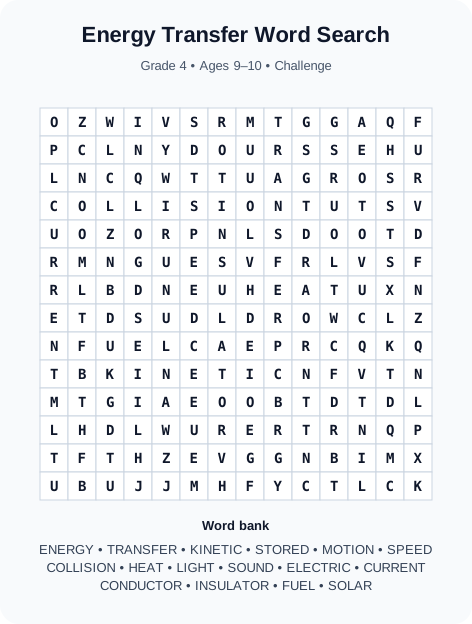
Trace energy through motion, collisions, heat, light, sound, and electric current with a Grade 4 word search, investigations, and answer key.
For parents and caregivers
What your child will practice
- Use evidence to connect an object's motion energy with its speed and the energy transferred in a collision.
- Identify heat, light, sound, and electric current as ways energy can be transferred.
- Trace energy from sources such as the Sun or fuel through a simple everyday system.
How to use this puzzle at home
- Preview the word bank and ask your child to find terms for energy sources, forms, and transfer pathways.
- Complete the puzzle, then read each definition and trace energy through a lamp, bicycle, or rolling toy.
- Roll one toy gently and then faster into a safe lightweight object, comparing the motion after each collision.
- Find one conductor and one insulator used safely at home, without opening appliances or touching electrical outlets.
Word List
- ENERGY
- TRANSFER
- KINETIC
- STORED
- MOTION
- SPEED
- COLLISION
- HEAT
- LIGHT
- SOUND
- ELECTRIC
- CURRENT
- CONDUCTOR
- INSULATOR
- FUEL
- SOLAR
Printable Puzzle
Vocabulary guide
Use these short definitions before or after the word search. Ask your child to explain a few in their own words.
- Energy
- The ability to cause motion, heating, light, sound, or another change in a system.
- Transfer
- The movement of energy from one object, place, or system to another.
- Kinetic
- Describes the energy an object has because it is moving.
- Stored
- Describes energy kept in a system and available to cause a later change.
- Motion
- A change in an object's position compared with a reference point over time.
- Speed
- A measure of the distance an object travels during a certain amount of time.
- Collision
- An event in which moving objects strike each other and transfer energy.
- Heat
- Energy transferred from a warmer object or region to a cooler one because of a temperature difference.
- Light
- A form of energy that travels through space and can be detected by eyes.
- Sound
- Energy carried through matter by vibrations that can be detected by ears.
- Electric
- Describes energy associated with electric charges and their movement or position.
- Current
- The organized flow of electric charge through a material or circuit.
- Conductor
- A material through which thermal or electrical energy can transfer easily.
- Insulator
- A material that slows the transfer of thermal or electrical energy.
- Fuel
- A material that stores chemical energy that can be released during a reaction.
- Solar
- Describes energy from the Sun that reaches Earth mainly as light.
Talk about the science
- What evidence shows that a faster moving object can transfer more energy in a collision?
- Where does energy enter and leave a battery-powered device?
- How do a conductor and an insulator affect energy transfer differently?
- Why is energy transferred or changed rather than simply used up?
Try one more thing
Extension activity
Choose an everyday system such as a toaster, solar light, bicycle, or speaker. Draw a sequence showing the energy source, at least two transfers or changes, useful outputs, and evidence of energy reaching the surroundings.
Teacher and tutor note
Classroom adaptation
After the search, set up stations for rolling-object collisions, sunlight on differently colored surfaces, and sound from vibrating rulers. Teams draw an energy-transfer diagram for each station and cite observed evidence.
Keep learning
Keep learning at Grade 4
Ready for another puzzle?
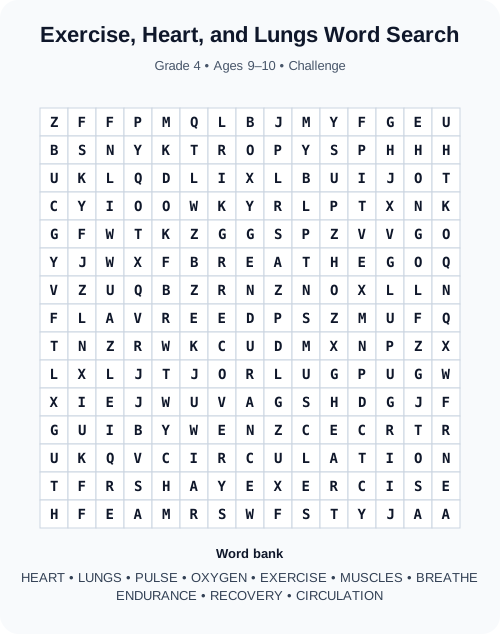
Exercise, Heart, and Lungs Word Search
Continue with a different science topic at a familiar level.
Continue learning