Magnets, Electricity, and Circuits Word Search
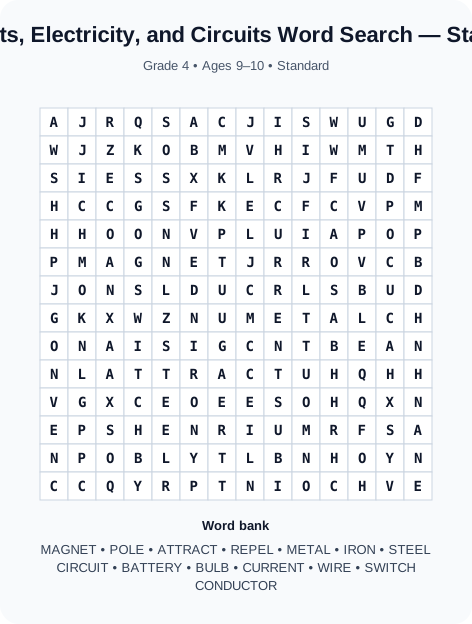
- Free
- No account
- Answer key
- Standard
- About 20 min
- 14 words
One printable file with the activity first and the answer key after it.
Choose the right level
Easy, Standard, or Challenge
Easy
8 words · About 12 min
Standard
14 words · About 20 min
Challenge
20 words · About 28 min
Download a free Grade 4 magnets, electricity, and circuits word search PDF with three levels, answer keys, definitions, and a circuit activity.
For parents and caregivers
What your child will practice
- Identify the components and continuous pathway required for a simple electric circuit to operate.
- Compare electrical conductors and insulators while reviewing magnetic attraction and repulsion.
How to use this puzzle at home
- Preview the word bank and identify which terms describe circuit parts, materials, or magnetic interactions.
- Complete the chosen puzzle level and check it with the corresponding answer key.
- Use a diagram or supervised low-voltage kit to trace a complete pathway from battery through components and back.
What you need
- Printed worksheet or PDF viewer
- Pencil or highlighter
- Optional supervised low-voltage circuit kit
Word List
- MAGNET
- POLE
- ATTRACT
- REPEL
- METAL
- IRON
- STEEL
- CIRCUIT
- BATTERY
- BULB
- CURRENT
- WIRE
- SWITCH
- CONDUCTOR
Printable Puzzle
Open Puzzle PDFOpen Answer KeyDownload Worksheet + Answer Key
Vocabulary guide
Use these short definitions before or after the word search. Ask your child to explain a few in their own words.
- Magnet
- An object that creates a magnetic field and can attract certain materials.
- Pole
- One of the two ends or regions of a magnet where effects are strongest.
- Attract
- To pull an object or opposite magnetic pole closer.
- Repel
- To push an object or like magnetic pole farther away.
- Metal
- A class of materials that usually conducts heat and electricity, though not every metal is strongly magnetic.
- Iron
- A metal that is strongly attracted to common permanent magnets.
- Steel
- A material made mostly from iron that can often be attracted to a magnet.
- Circuit
- A complete pathway through which electric current can travel.
- Battery
- A source that changes stored chemical energy into electrical energy for a circuit.
- Bulb
- A circuit component that changes electrical energy into light and heat.
- Current
- The movement of electric charge through a complete circuit.
- Wire
- A conducting path, often metal covered by insulation, that connects circuit components.
- Switch
- A device that opens or closes a circuit pathway.
- Conductor
- A material through which electric charge can move relatively easily.
- Insulator
- A material that resists the movement of electric charge.
- Charge
- A property of matter associated with electric attraction, repulsion, and current.
- Electromagnet
- A magnet produced when electric current travels through a wire coil.
- Coil
- Wire wound into loops, often used to strengthen an electromagnet.
- Motor
- A device that uses electric current and magnetic forces to produce motion.
- Series
- A circuit arrangement with components connected along one continuous path.
Talk about the science
- Why must a circuit have a complete pathway for a bulb to light?
- How are conductors and insulators useful in the same electrical device?
- How does an electromagnet connect electricity with magnetic force?
Quick check
Measurable exit ticket
Exit ticket: draw and label a closed circuit containing a battery, wires, switch, and bulb. Add one conductor and one insulator example and explain what happens when the pathway is opened.
Try one more thing
Extension activity
Draw two versions of the same circuit, one open and one closed. Trace the current path, predict the bulb's behavior, and add a labeled electromagnet showing a battery, wire coil, and iron core.
Teacher and tutor note
Classroom adaptation
After the puzzle, groups inspect a low-voltage circuit diagram or teacher-approved kit. They identify each component, predict whether selected materials will conduct, and troubleshoot one open pathway using evidence rather than trial alone.
Differentiation and accommodations
Extra support
Begin with the Easy version and provide a large circuit diagram with movable component labels.
More challenge
Use the Challenge version, then compare a permanent magnet with an electromagnet and explain one useful advantage of each.
Access options
- Provide preconnected low-voltage components or a digital circuit model.
- Allow oral troubleshooting and labeled diagrams instead of extended writing.
- Keep magnets away from medical and assistive devices and offer a recorded demonstration.
Accessibility
All terms, definitions, and instructions appear as selectable HTML with zoom and keyboard support. The optional circuit and magnet work requires adult supervision and may not suit every assistive device, so equivalent diagrams, digital models, and verbal descriptions should be available.
Keep learning
Keep learning at Grade 4
Ready for another puzzle?
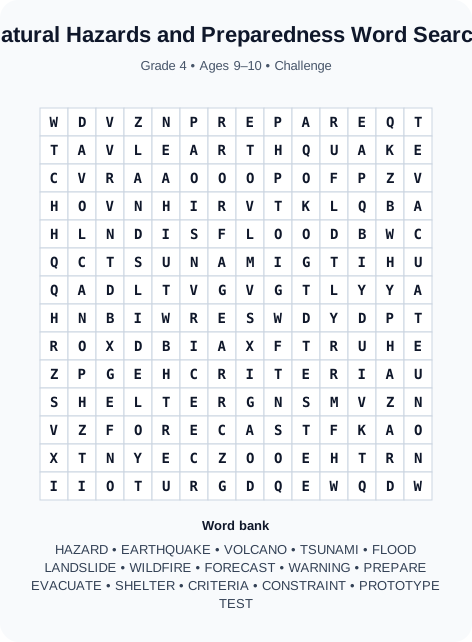
Natural Hazards and Preparedness Word Search
Continue with a different science topic at a familiar level.
Continue learning