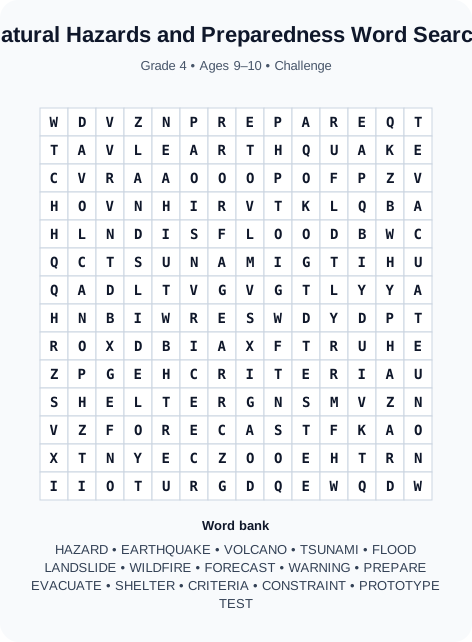
Natural Hazards and Preparedness Word Search
- Free
- No account
- Answer key
- Challenge
- About 24 min
- 16 words
Combine hazard science, preparedness, and engineering design with a Grade 4 printable word search, family-safe activities, and answer key.
For parents and caregivers
What your child will practice
- Use hazard information to explain how warnings and preparedness can reduce harm.
- Define an engineering problem with criteria for success and constraints on a possible solution.
- Compare, test, and improve models designed to reduce the effects of a natural hazard.
How to use this puzzle at home
- Preview the words calmly and identify hazards that are relevant to your region without using frightening images.
- Complete the search, then sort terms into natural events, safety actions, information, or engineering design.
- Review one trusted local emergency guidance source and your household meeting or communication plan.
- Discuss why the safest action depends on the hazard and why children should follow caregivers and authorities.
Word List
- HAZARD
- EARTHQUAKE
- VOLCANO
- TSUNAMI
- FLOOD
- LANDSLIDE
- WILDFIRE
- FORECAST
- WARNING
- PREPARE
- EVACUATE
- SHELTER
- CRITERIA
- CONSTRAINT
- PROTOTYPE
- TEST
Printable Puzzle
Vocabulary guide
Use these short definitions before or after the word search. Ask your child to explain a few in their own words.
- Hazard
- A natural event or condition with the potential to harm people, property, or ecosystems.
- Earthquake
- Sudden ground shaking caused by a rapid release of energy when rocks move.
- Volcano
- An opening in Earth's crust through which molten rock, gases, and ash may erupt.
- Tsunami
- A series of large ocean waves usually caused by sudden movement of the seafloor.
- Flood
- An overflow of water onto land that is normally dry.
- Landslide
- The rapid downhill movement of rock, soil, and debris under the force of gravity.
- Wildfire
- An uncontrolled fire that spreads through vegetation in a natural or developed area.
- Forecast
- A science-based estimate of future conditions or the likelihood of an event.
- Warning
- An official notice that a dangerous event is occurring, approaching, or likely soon.
- Prepare
- To plan, gather appropriate supplies, and practice safe actions before an emergency.
- Evacuate
- To leave a dangerous place for a safer location when directed by authorities.
- Shelter
- A protected place used to reduce exposure to a specific hazard.
- Criteria
- The features or outcomes that a successful design solution should achieve.
- Constraint
- A limit on a design, such as available time, materials, cost, space, or safety.
- Prototype
- An early model of a proposed solution built so its performance can be examined.
- Test
- A planned procedure for collecting evidence about how well a design performs.
Talk about the science
- How are a forecast and a warning different, and how can each support preparedness?
- Why can a design reduce a hazard's effects without stopping the natural event?
- Which criteria and constraints matter when designing a model flood barrier?
- How should test evidence be used when two teams prefer different solutions?
Try one more thing
Extension activity
Research one locally relevant hazard using a trusted public source. Create a one-page preparedness guide with the hazard evidence, official warning source, caregiver-approved actions, and a labeled design idea that reduces one likely impact.
Teacher and tutor note
Classroom adaptation
After the puzzle, present a local hazard scenario and approved safety guidance. Teams define one impact-reduction problem, name criteria and constraints, build a small model such as a flood barrier, and compare test evidence.
Keep learning
Keep learning at Grade 4
Ready for another puzzle?
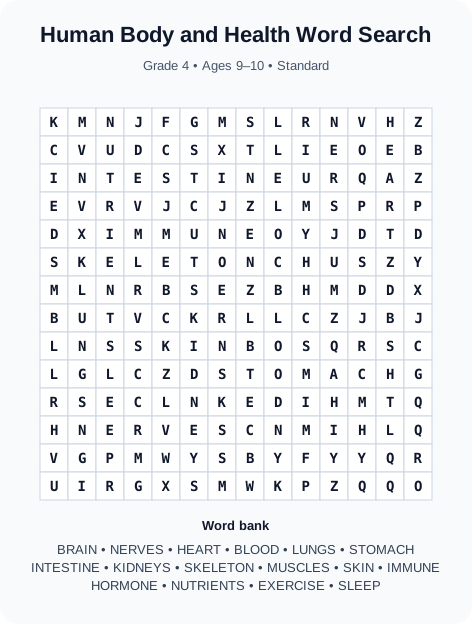
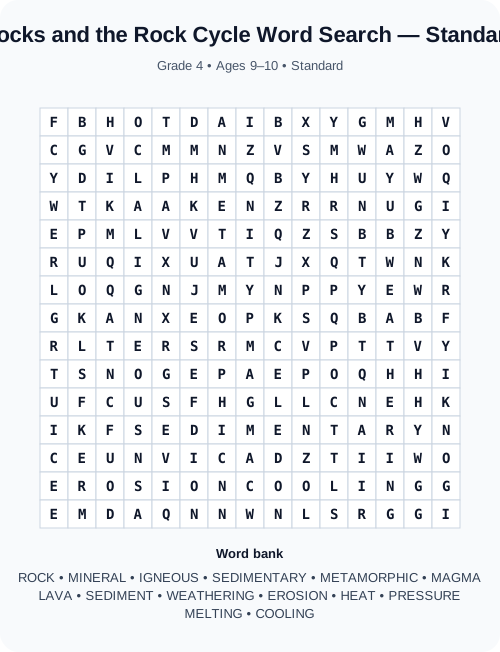
Rocks and the Rock Cycle Word Search
Continue with a different science topic at a familiar level.
Continue learning